Tempo compresses hour-long video with a 2B vision model so a 4B LLM can answer
Researchers at Meta AI and KAUST published Tempo on April 9, 2026, a way to hand a long video to a small vision-language model first and let a larger language model answer the question afterwards. On LVBench, a benchmark whose clips average 4101 seconds, the authors report their 6B system scoring 52.7 against 48.2 for VideoChat-Flash 7B, the strongest specialised baseline in their table, and against 30.8 for GPT-4o and 33.1 for Gemini 1.5 Pro.
The small model does the reading and the large one does the reasoning. A Qwen3-VL-2B-Instruct compressor takes an eight-frame chunk of video together with the user’s question and writes out a short run of memory tokens that hold what the chunk contains, and a Qwen3 4B language model then reads the whole condensed sequence with timestamps attached and produces the answer. A linear projector joins the two, for 6B parameters in total. The compressor is the part that could in principle sit on a phone, since it never sees more than a few seconds of video at a time.
How many tokens each chunk gets is decided during the same forward pass. The authors insert a yes or no question about whether the segment is relevant to the query, read the difference between the two logits as a score, and keep more memory tokens for chunks that score high, spending between 0.5 and 16 tokens per frame under a fixed overall budget of 4K or 8K visual tokens. On LVBench under the 4K budget the measured average comes to 2.9 tokens per frame. The tighter budget also scores better than the looser one on that benchmark, 52.7 against 52.3, and on the long subset of Video-MME, 57.8 against 57.0. Raising the cap to 2048 frames and a 12K budget brings LVBench to 53.7.
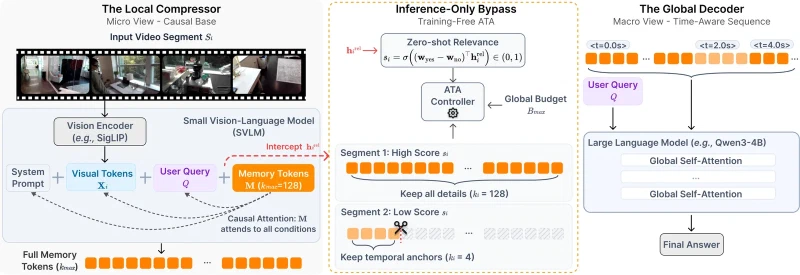
On the other three benchmarks the authors report 67.8 on Video-MME under the 4K budget against 65.3 for VideoChat-Flash and 61.9 for the Qwen3-VL 2B model the compressor starts from, plus 75.6 on MLVU and 65.1 on LongVideoBench. All of these are accuracy scores run through lmms-eval, not speed or memory figures. Nothing in the paper was measured on a phone, a tablet or any other edge device. Training used 32 and then 64 Nvidia H100 GPUs, the paper reports no latency, throughput or memory footprint for the compressor on mobile hardware, and the on-device case rests on the size of the model rather than on a measurement.
The authors state that all training datasets they used are publicly available, and they link code and a project page from the paper, with the repository carrying an Apache 2.0 license. They describe no weights release in the paper itself. Their stated next steps are to let the compressor decide for itself when it has gathered enough evidence to stop, which they say would bottleneck inference latency as things stand.