PalmBench finds iPhones running local LLMs about three times faster than Android phones
Researchers at the University of Wisconsin-Madison, Amazon Web Services AI and Uber ran quantised language models across eight phones and edge boards and measured the widest gap between Apple and everything else. In PalmBench, published as a conference paper at ICLR 2025, TinyLlama-1.1B at 4-bit reached close to 100 tok/s on an iPhone 15 Pro against roughly 30 tok/s on the fastest Android phone in the set, a Pixel 7. The authors report that the three-year-old iPhone 12 Pro also stayed ahead of every Android device and of Nvidia’s Jetson Orin Nano.
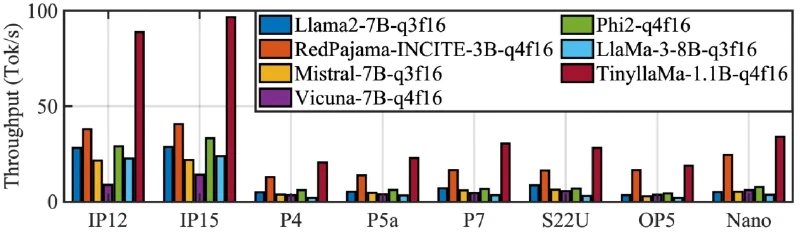
The test bed covers a Pixel 4, Pixel 5a, Pixel 7, Galaxy S22 Ultra, iPhone 12 Pro, iPhone 15 Pro, an Orange Pi 5 and a Jetson Orin Nano, each with 6 GB or 8 GB of memory. Models include Llama-2-7B, Llama-3 and 3.1-8B, Llama-3.2-3B, Mistral-7B, Vicuna, Qwen2, Phi-2, Gemma-2-2B, RedPajama-INCITE-3B and TinyLlama-1.1B, quantised from 2-bit to 8-bit and additionally with GPTQ, AWQ and FasterTransformer. The team used two runtimes, MLC LLM and llama.cpp, and states that llama.cpp does not run on iPhone, so the cross-platform numbers come from MLC.
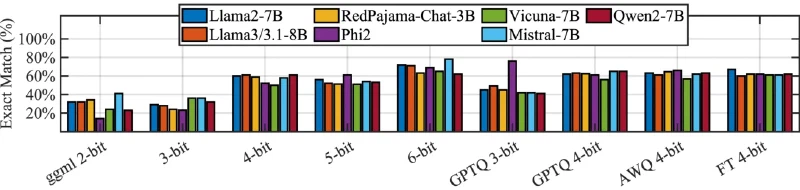
Quantisation costs more answer quality than the bit count alone suggests. Scoring each quantised build’s exact match against the unquantised model’s own answers on SQuAD and Natural Questions, the paper’s figure puts 4-bit builds between about 50 and 61 percent, 6-bit between roughly 62 and 78 percent, and 2-bit and 3-bit builds as low as 15 percent. The authors note that 3-bit did not clearly beat 2-bit, and that 5-bit landed close to 4-bit while consuming more resources and degrading more than any 4-bit variant.
The 4-bit builds drew more power than the 3-bit ones rather than less. The paper’s table records 4-bit consuming more energy on all eight devices for the same 3B Llama model, rising from 10.13 to 13.05 mWh on the iPhone 15 Pro and from 14.54 to 14.68 mWh on the Pixel 7, which the authors put down to the higher-precision build occupying more GPU duty cycles. Surface temperature measured with a FLIR C5 thermal camera peaked at 75.4 °C on the Orange Pi 5 and 46.3 °C on the iPhone 15 Pro at 4-bit. Harmful output tracked the bit count more cleanly, with the hallucination rate on Llama-3-8B at 34.7 percent for 2-bit against 9.1 percent for 4-bit GPTQ and 7.9 percent at 8-bit.
The authors name several limits on their own work. They cannot compare the two runtimes on iOS because llama.cpp does not support the iPhone, they profiled total memory only at 3-bit and 4-bit because higher-bit MLC builds exceeded the devices’ capacity, and they dropped models that would not fit at all, such as the unquantised Llama-2-7B at 13.11 GB. They also note that both runtimes expose few decoding options, with beam search unavailable in llama.cpp. Artificial Analysis has since run an independent benchmark of 33 quantised models on a single iPhone 17 Pro.