One shared on-device LLM keeps a context per app and switches in 0.27 seconds
Researchers at Peking University, the Beijing University of Posts and Telecommunications and Tsinghua University published LLMS on March 18, 2024, an operating system service that keeps a separate conversation context for every app calling one shared on-device language model. Serving eight active contexts of Llama2-7B on a Jetson Orin NX, the authors measure 0.27 seconds to switch to another app’s context. They report switches up to 20 times and on average 9.7 times faster than a baseline that swaps the same chunks but quantises every one to 8 bits, modelled on the server system vLLM.
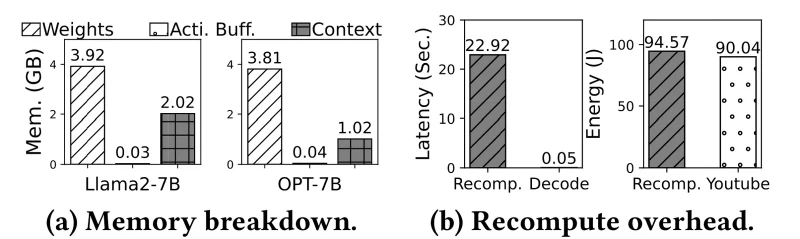
The premise is one model held by the operating system instead of a copy inside each app, the way Android AICore serves Google apps, with every caller keeping its own KV cache, the stored attention state that lets a model continue a conversation without rereading it. On a Xiaomi 14 running llama.cpp, the authors measure one Llama2-7B context at the full 4k-token window at 2.02 GB, against 3.92 GB for the 4-bit weights, so a few apps holding contexts outweigh the model they all share. Letting the phone’s low-memory killer reclaim that memory means rebuilding the context by running the text through the model again, which the authors put at 22.92 seconds and 94.57 J on the same phone, close to the 90.04 J they measure for one minute of YouTube.
What moves to storage is the KV cache, cut into chunks of 16 tokens, while the prompt and output text stay resident. The service quantises each chunk to 8, 4 or 2 bits according to how much attention its tokens draw from the rest of the context, holding a 50 percent average set by the system, then refills a context by reading some chunks from disk while recomputing others from the stored text and overlapping the two. The authors report twice the compression ratio of static quantisation at negligible accuracy loss, where compressing every chunk alike to 4 bits or 2 bits costs up to 59 percent and 99 percent of accuracy.
Each of the three techniques carries part of that 0.27 seconds, which the authors break down as 0.42 seconds without the per-chunk compression, 0.62 seconds without the eviction order and 1.62 seconds without the read-and-recompute pipeline. The prototype is 3.5k lines of Python and C++ on Hugging Face Transformers and mllm, run on a Jetson Orin NX, a Jetson TX2 and a Xiaomi 14 with a Snapdragon 8 Gen 3, each with 8 GB of RAM, using Llama2-7B and OPT-6.7B over 72-hour traces synthesised from six datasets, and the authors state that it leaves token generation speed within 5 percent of running without it. The paper is on arXiv under a CC BY 4.0 license, and the same four authors published the work at SenSys 2026 in Saint-Malo in May 2026 as An Efficient Context Management System for On-Device LLMaaS.