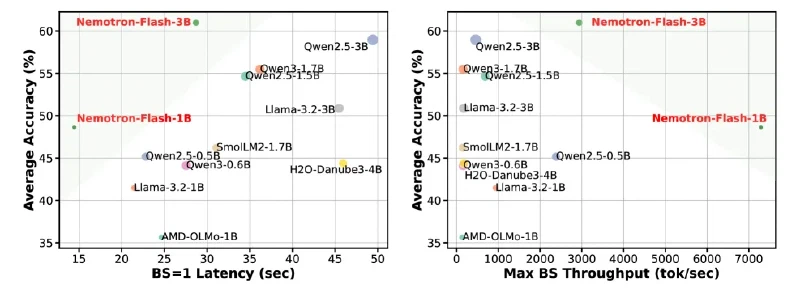
Nemotron-Flash-1B decodes 1.9 times faster than Qwen3-0.6B on an H100
Nvidia published Nemotron-Flash on November 24, 2025, a family of small language models built around measured decoding latency instead of parameter count. Nvidia reports Nemotron-Flash-1B decoding 8k tokens in 14.45 seconds on a single Nvidia H100 at batch size 1, against 27.55 seconds for Qwen3-0.6B, while averaging 49.63 across 16 benchmarks to Qwen3-0.6B’s 44.11. The paper was accepted at NeurIPS 2025.
The models mix three kinds of layer rather than using attention throughout. Nvidia interleaves DeltaNet and Mamba2 layers, operators that carry a fixed-size state instead of a cache that grows with the context, with a small number of ordinary attention layers, and an evolutionary search picked which operator goes where. Nemotron-Flash-1B holds 0.96B parameters in 12 blocks with only 2 full attention layers, and Nemotron-Flash-3B holds 2.7B parameters in 18 blocks with 3. Nvidia built both wider and shallower than other models of the same size, where Qwen3-0.6B stacks 28 layers, and writes that deep and thin models are parameter efficient but sit off the accuracy-latency frontier.
Nemotron-Flash-3B averages 60.98 across the same 16 tasks, which cover MMLU, commonsense reasoning, math, coding and recall, against 58.96 for Qwen2.5-3B and 55.47 for Qwen3-1.7B. On the same H100, with all models running through TensorRT-LLM AutoDeploy kernels and CUDA Graph, Nvidia measured 28.71 seconds for the 3B against 49.40 for Qwen2.5-3B and 36.20 for Qwen3-1.7B, so 1.7 and 1.3 times lower latency. Throughput was measured separately, with a 32k-token input at the largest batch size that still fits in memory, and Nvidia reports 2939 tok/s for the 3B against 459 and 157 for the two Qwen models, and 7289 tok/s for the 1B against 160 for Qwen3-0.6B. Every figure here is Nvidia’s own, taken on data centre GPUs, and the paper gives no phone or embedded measurements, with the earlier depth and operator studies run on an Nvidia A100.
Nvidia trained both models on 4.5T tokens using 256 H100 GPUs and released three checkpoints on Hugging Face, Nemotron-Flash-1B, the 3B base model and an instruction-tuned Nemotron-Flash-3B-Instruct, which averages 52.84 across MMLU, GPQA, GSM8K and IFEval against 48.17 for Qwen2.5-1.5B. The model cards set the licence to Creative Commons Attribution-NonCommercial 4.0, so the weights are downloadable but not licensed for commercial use, and neither Apache nor an Nvidia open model licence applies. Running them needs the TensorRT-LLM AutoDeploy attention kernel alongside the Mamba2 and FlashLinearAttention implementations, since Nvidia states that vLLM and TensorRT-LLM do not support DeltaNet-style linear attention on their own.