Meta's MobileLLM-Flash goes shallow and wide for 1.8 times faster prefill
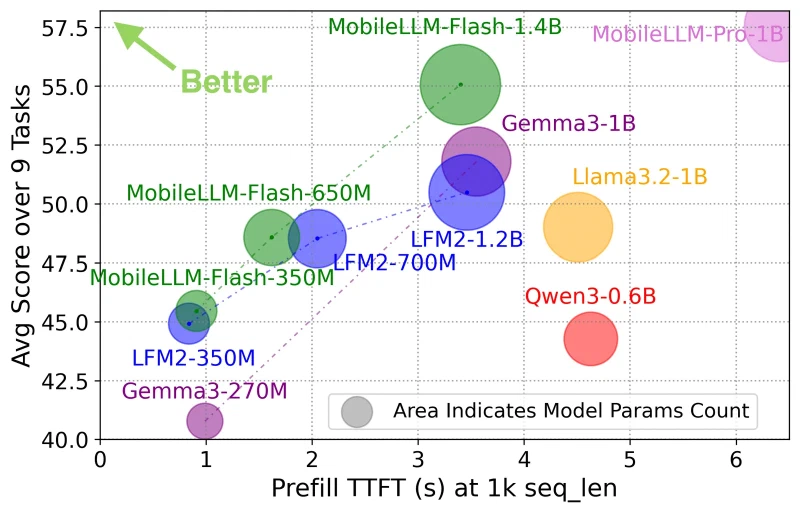
Meta AI published MobileLLM-Flash on March 16, 2026, three models of 350M, 650M and 1.4B parameters whose shapes were picked by measuring how fast each candidate actually ran on a phone. Meta reports the family reaching up to 1.8 times faster prefill and 1.6 times faster decode than Liquid AI’s LFM2 models on mobile CPUs, at comparable or higher accuracy, with support for up to 8k tokens of context.
Meta’s first MobileLLM paper argued in 2024 that deep and thin networks win below a billion parameters, and the Flash paper states that such deep-and-thin structures often fail to improve on-device latency. Meta exported 100 architectures to a phone and found parameter count a poor predictor of measured prefill and decode speed, at a Kendall rank correlation of 0.40, with FLOPs little better at 0.46 and 0.55. The 1.4B model therefore runs 16 layers at a width of 2048, against the 30 layers at 1280 of MobileLLM-Pro-1B.
Meta ran the latency tests on a Samsung Galaxy S25, a phone with a Snapdragon 8 Elite chipset, an octa-core CPU and 12 GB of memory, exporting each model through ExecuTorch to the XNNPACK CPU backend at 4-bit weights, 8-bit dynamic activations and a quantised KV cache, on 4 CPU threads and averaged over three runs after a warmup. At a 2k context the 650M model reaches its first token in 3.34 s against 6.01 s for LFM2 700M, and decodes at 85.35 tok/s against 53.57 tok/s. Meta repeated the 1k-context test on an iPhone 17, where the 650M model takes 2.81 s to the first token against 3.40 s for LFM2 700M.
Most of the speed comes from letting some layers skip attention, so a token passes through those blocks without being compared to every earlier token. The 350M model keeps full attention in 7 of its 12 layers and the 650M model in 8 of 13, while the 1.4B model attends in all 16. Meta reports that skipping consistently beat sliding window attention, which instead limits each token to a fixed span of recent ones, and that more than three skipped layers in a row costs accuracy at the same latency, dropping TriviaQA exact match from 33.2% to 8.8%.
Meta built the three models by pruning a shallow 1.8B variant of MobileLLM-Pro and inheriting its weights, which the paper says took about 35% of the tokens that pretraining MobileLLM-Pro required. Across nine reasoning and knowledge tasks Meta reports averages of 45.46, 48.57 and 55.06 for the three sizes, against 44.92, 48.52 and 50.48 for LFM2 at 350M, 700M and 1.2B, 51.79 for Gemma 3 1B and 49.01 for Llama 3.2 1B. After instruction tuning, the 1.4B model scores 47.89 on MMLU and 46.34 on HumanEval, against 49.30 and 37.80 for Llama 3.2 1B. The paper announces no release of the weights.