MLPerf Mobile v6.0 adds Llama tests in 1B, 3B and 8B sizes
MLCommons announced MLPerf Mobile v6.0 on June 15, 2026, adding generative AI tests that run Llama on an Android device and report token throughput. The new workload comes in 1B, 3B and 8B parameter sizes, using Llama 3.2 1B Instruct, Llama 3.2 3B Instruct and Llama 3.1 8B Instruct.
Each size runs twice, once against TinyMMLU, a small multiple-choice knowledge set, and once against IFEval, which checks whether a model obeys the instructions in a prompt, according to the task configuration in the app repository. MLCommons says the tests run on devices with enough memory through the CPU without tailored acceleration, and that v6.0 adds NPU-accelerated execution of Llama 3.1 8B Instruct on Qualcomm Snapdragon 8 Elite Gen 5. The v6.0 app release of June 9, 2026 also brings support for MediaTek Dimensity 9500 chips and updates support for the Samsung Exynos 2600.
The rest of the suite covers image classification with MobileNetV4 on ImageNet, object detection on COCO 2017, segmentation with MOSAIC on ADE20K, language understanding with MobileBERT on SQuAD 1.1, super resolution with EDSR, and Stable Diffusion 1.5 on COCO captions, as the benchmark page lists them. Almost every test runs in the single stream scenario, where the score is the 90th percentile latency for one query at a time, and image classification also runs an offline pass scored as throughput. Stable Diffusion, the first generative test in the suite, arrived in the v4.1 app release of February 11, 2025. Mostafa El-Khamy, co-chair of the MLPerf Mobile working group, had set out the plan in May 2024.
Looking ahead, the MLPerf Mobile group is working to add generative AI tasks to a future version of the benchmark suite.
Results come from chip and device makers that run the app and submit their logs. The published v6.0 results hold one submission in the closed division, from Samsung on an Exynos 2600 phone, and it covers the vision tests, language understanding, super resolution and Stable Diffusion rather than the new Llama ones. Samsung’s logs give a 90th percentile single stream latency of 0.56 ms for image classification, 0.83 ms for MobileBERT and 1.87 s for one Stable Diffusion image. The v5.0 round carried submissions from Samsung and Qualcomm Innovation Center.
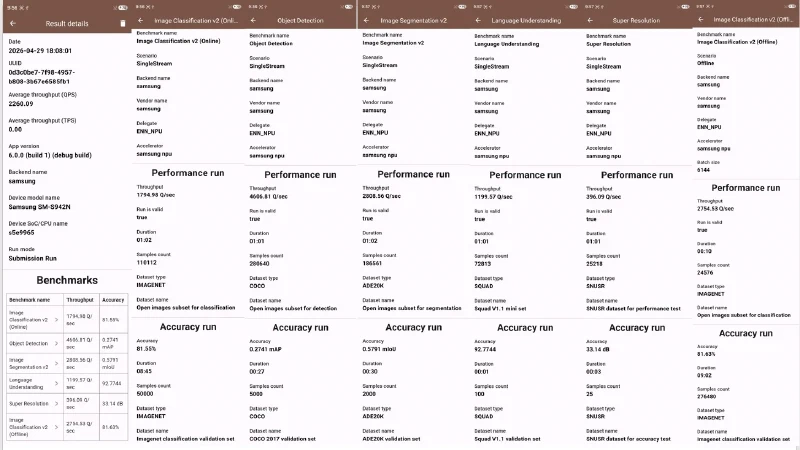
Submissions are held back until review closes under the MLCommons submission rules, which keep every result confidential inside a review committee after the deadline and let submitters file objections that the committee then decides. MLCommons publishes the accepted runs in the results table on the MLPerf Inference Mobile page, with the logs and calibration notes in a per-round repository on GitHub. The app is available through Google Play, the Apple App Store and the MLPerf Mobile repository under the Apache 2.0 license.