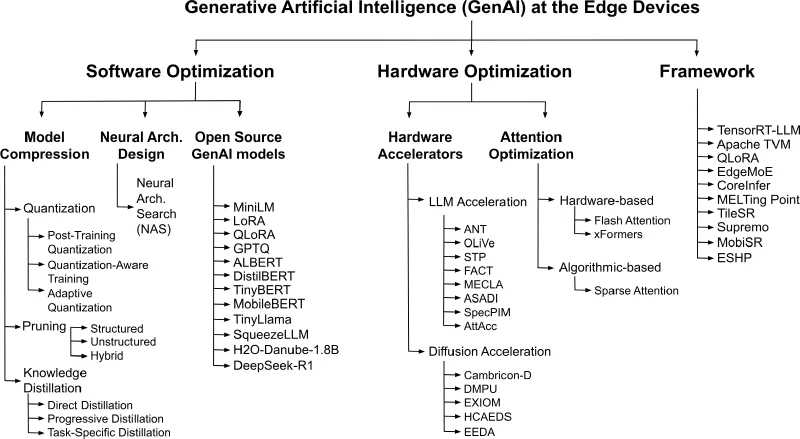
GenAI at the edge survey lists 12 accelerators, 8 of them only simulated
Seven researchers at Johns Hopkins University and Duke University published a survey of generative AI on edge devices on February 19, 2025. Most of the accelerator hardware it collects has not been built. Its table of 12 accelerators for language and diffusion models covers 8 simulator studies against 4 fabricated chips, and the highest peak energy efficiency in it is 74.34 TOPS/W, from a 28nm computing-in-memory chip designed for Stable Diffusion.
Compression is the part the survey treats as settled enough to quantify, and it attributes every figure to the work it reviews. It reports unstructured pruning reaching up to 60 percent sparsity on large models and a sparsity-aware inference system turning that into a 3 times speedup, while structured pruning that removes whole components gives about 2 times with little quality loss. Quantisation has been taken to 1 bit per weight in work such as BitNet, and the survey names what is still open there as holding generation quality under extreme compression and finding efficient ways to train quantised models on the edge devices themselves rather than only to run them.
The frameworks chapter is where the survey names hardware a reader can buy. It cites a measurement that applying NVIDIA’s TensorRT to transformer models on a Jetson Xavier cuts latency by over 60 percent with negligible accuracy loss, and points to MELTing Point, a benchmark suite that tracks language model energy use and memory footprint across smartphones and Jetson boards. The authors state that no dedicated survey of generative AI at the edge existed before theirs, close by naming model personalisation and security across distributed edge nodes as the challenges that persist, and publish on arXiv under a Creative Commons Attribution 4.0 license.