Gemma 4 lands on the edge with Agent Skills in Google AI Edge Gallery
Google DeepMind has launched Gemma 4 under the Apache 2.0 licence, and the Google AI Edge team has described how the E2B and E4B variants run on edge hardware. The models support more than 140 languages and a 128K context window.
Gemma 4 enables multi-step planning, autonomous action, offline code generation, and even audio-visual processing, all without specialized fine-tuning.
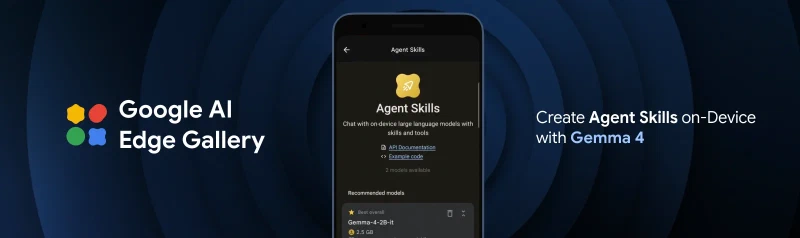
The Google AI Edge Gallery app on iOS and Android gains Agent Skills, which Google calls one of the first applications to run multi-step, autonomous agentic workflows entirely on-device. The examples given are querying Wikipedia, turning speech input into charts and flashcards, pairing photos with generated music, and building a small app that plays animal calls through conversation alone.
For in-app deployment Google points to LiteRT-LM. It reports that Gemma 4 E2B runs in under 1.5 GB of memory on some devices using 2-bit and 4-bit weights with memory-mapped per-layer embeddings, and that GPU optimisations process 4,000 input tokens across two skills in under 3 seconds. Constrained decoding enforces structured output, and dynamic context lengths let a single model span CPUs and GPUs.
On smaller hardware, LiteRT-LM reaches 133 prefill and 7.6 decode tokens per second on a Raspberry Pi 5 CPU, and 3,700 prefill and 31 decode tokens per second on the NPU of a Qualcomm Dragonwing IQ8, the processor behind the Arduino VENTUNO Q.
Gemma 4 is available with CPU and GPU support on Android and iOS, system-wide on Android through the new AICore Developer Preview, on Windows, Linux and macOS via Metal, and in the browser through WebGPU. Google also released a Python package and a litert-lm CLI for Linux, macOS and Raspberry Pi, with tool calling included.