ElastiLM resizes a shared phone LLM per request and switches in 0.31 seconds
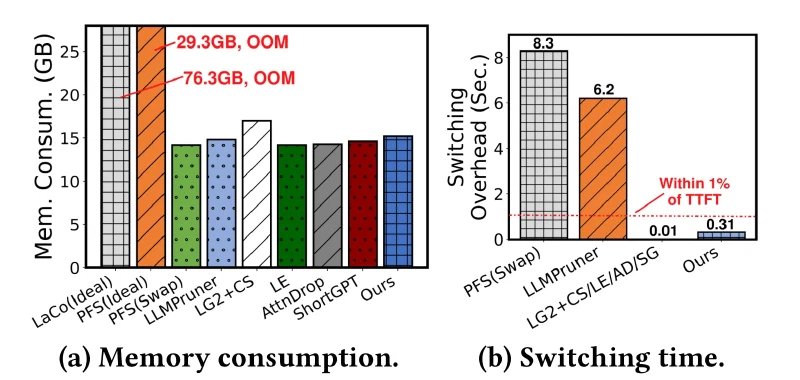
Researchers at Peking University and Beijing University of Posts and Telecommunications published ElastiLM on September 8, 2024, a phone-side language model service that resizes itself for every request. Running LLaMA-7B on a Redmi K60 Champion Edition with a Snapdragon 8 Gen 2, the authors measure 0.31 seconds to switch from one sub-model to another, against 8.3 seconds for swapping in a separately pretrained model of the right size and 6.2 seconds for the pruning method LLMPruner.
The setup the paper assumes is one model held by the operating system that every app calls, the way Android AICore serves apps like Gboard smart reply. Those callers want different things from it, and the authors put an always-on voice assistant that needs an answer almost immediately next to a background screen-event recorder that can wait. ElastiLM takes a latency budget along with each request and then picks how much of the model to run and how much of the prompt to keep, in steps of 10 percent, rather than running one fixed model at one fixed speed.
Accuracy is what pays for the speed. Cutting the prompt drops words the model might have needed and pruning removes whole attention heads and MLP neurons, and the split matters as much as the total, since the authors show one science question that half the prompt with an 80 percent sub-model answers correctly while 80 percent of the prompt with a half-size sub-model gets wrong. Preparing a model costs 68.3 GPU hours on a server with NVIDIA A40s, which the authors price at about $100 of rented time and put at 21.7 to 68.2 hours more than the pruning baselines. The service runs on four big CPU cores, and the authors state that as of August 2024 no mobile GPU or NPU could run ElastiLM or its baselines end to end, so their accelerator figures are projected from profiled latency rather than measured on a device.
Across the Redmi K60 Champion, a Mi 14 and a Redmi K70 Pro, the last two on Snapdragon 8 Gen 3, the authors report ElastiLM answering more requests correctly than seven baselines by 6.60 to 14.83 percent in absolute accuracy, 10.45 percent on average, on traces of 600 requests drawn from six datasets. Peak memory for LLaMA-7B sits at 15 to 17 GB, level with the baselines, while keeping a dedicated model per latency budget would take 29.3 GB or 76.3 GB and runs out of memory on all three phones, which carry 19 GB to 24 GB of RAM. Weight-only quantisation to 8 bits costs almost no accuracy and 4 bits about 3 percent absolute, by the authors’ measurement. The paper appeared at MobiCom 2025 in Hong Kong in November 2025 and is on arXiv under a CC BY 4.0 license.