Benchmark of 68 small language models finds architecture outweighs size on device
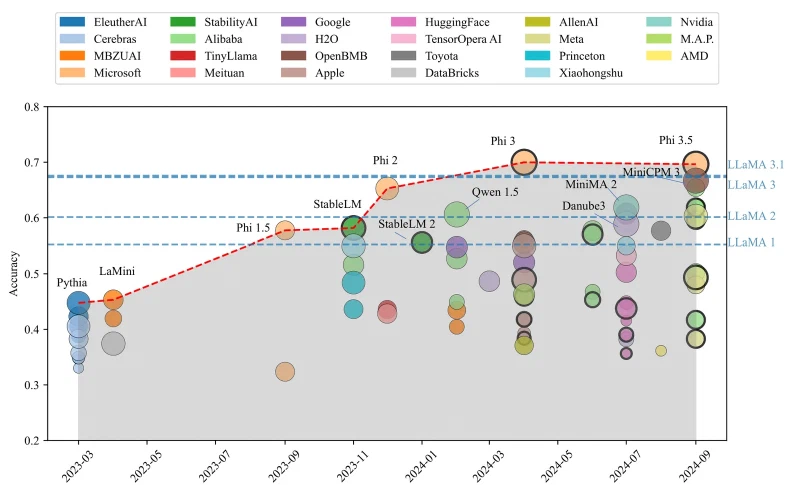
Ten researchers at Beijing University of Posts and Telecommunications, Peng Cheng Laboratory, the University of Cambridge, Xiaomi, Helixon Research and Flower Labs collected 68 small language models between 100M and 5B parameters, released by 24 organisations between OPT in May 2022 and Llama 3.2 in September 2024, and measured both their accuracy and their cost on edge hardware. In Demystifying Small Language Models for Edge Deployment, presented at ACL 2025, Microsoft’s Phi-3 and Phi-3.5-mini sit highest on the capability chart at about 70 percent average accuracy over 10 reasoning and knowledge datasets, level with the Llama 3.1 line the authors draw for comparison. The runtime half of the study covers the 20 models that llama.cpp supports, quantised to 4-bit and run with a 50-token prompt and 50 generated tokens.
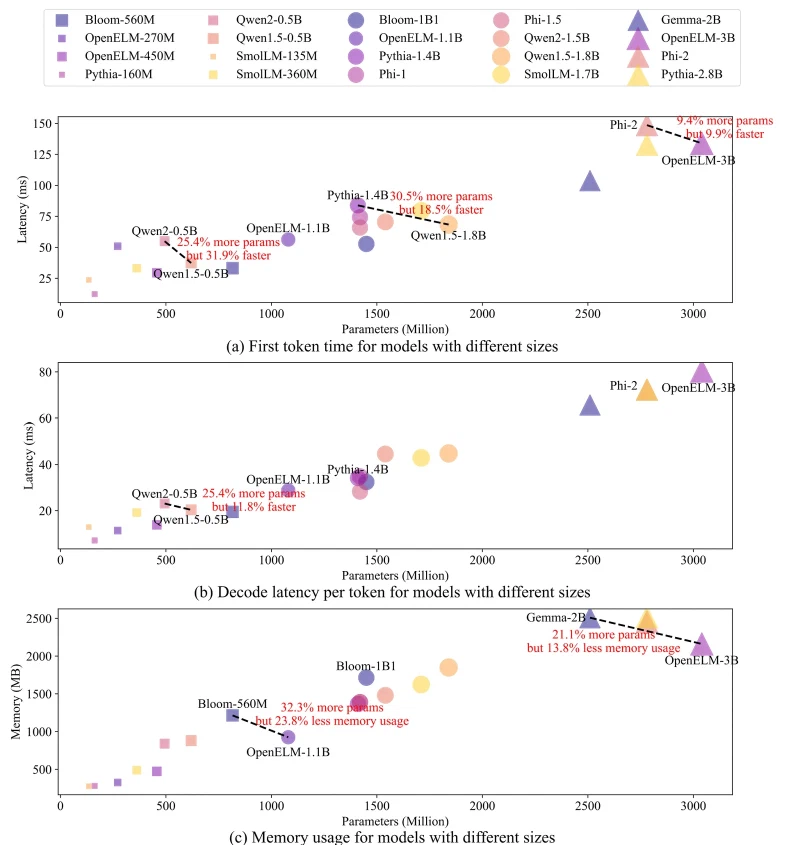
Parameter count predicts on-device latency poorly. The measurements put OpenELM-3B at 9.4 percent more parameters than Phi-2 but 9.9 percent faster to the first token, and Qwen1.5-0.5B at 25.4 percent more parameters than Qwen2-0.5B yet 31.9 percent faster to the first token and 11.8 percent faster per decoded token. Qwen1.5-1.8B carries 30.5 percent more parameters than Pythia-1.4B and still reaches the first token 18.5 percent sooner. The authors trace the gap to how a model spends its parameter budget, with Qwen2 sharing its input embedding and output layer and putting the saved weights into wider attention and feed-forward layers, which costs compute in the prefill stage.
Memory ran from 275 MB to 2456 MB across the 20 models, measured with llama.cpp on a Jetson Orin NX at a fixed 2048-token context. Vocabulary size moves that figure as much as parameter count does, and the paper reports Bloom-560M needing 492 MB of compute buffer for its 250,880-token vocabulary, 3.5 times what OpenELM-1.1B needs with 32,000 tokens. OpenELM-1.1B uses 23.8 percent less memory than Bloom-560M despite 32.3 percent more parameters, and OpenELM-3B 13.8 percent less than Gemma-2B despite 21.1 percent more, which the authors put down to the small vocabulary and to grouped-query attention, where several attention heads share one set of cached keys and values. Raising each model to its own maximum context window pushes Qwen2-0.5B past 6 GB, with compute buffer and KV cache making up 85 percent of the total for the Qwen2 models.
Quantisation paid off in decoding rather than in prefill. Testing five settings on Phi-1.5, the authors found Q4_K_M the strongest, roughly halving per-token decode latency against FP16, while at a 50-token prompt it cut the time to the first token by only 13 percent. Q6_K and Q3_K matched or exceeded FP16 on longer prompts, which the paper puts down to the alignment and padding their irregular bit widths force. The hardware gap was wider than the quantisation gap, with the Jetson’s GPU 40 times faster than the Meizu 18 Pro’s CPU at prefill but only 1.84 times faster at decode, and the Xiaomi 12S on a Snapdragon 8 Gen 1+ the fastest of the three phones, ahead of the Pixel 7 Pro and the Meizu on its Snapdragon 888.
The authors name two limits on their own work. They left math datasets out of the capability evaluation because of the gap between small models and larger ones on mathematical reasoning, and they confined the cost analysis to the 20 models llama.cpp supports so that the inference engine stayed constant, excluding every model it cannot load. The paper is free to read at the ACL Anthology under a Creative Commons Attribution 4.0 licence, and the same group had earlier measured 22 models from 0.5B to 7B on four Android phones, three of which reappear in this test bed. PalmBench adds power draw and surface temperature on comparable hardware, and Artificial Analysis has since reported quality, speed and memory together for 33 quantised models on one iPhone 17 Pro.