ClawMobile tries system commands before screen taps and finishes all six test tasks
Seven researchers at MBZUAI, City University of Hong Kong and one working independently published ClawMobile on February 26, 2026, an agent runtime that runs on the Android phone itself with no tethering to a host machine. The model is not on the device. The authors state that ClawMobile runs locally while model inference is performed remotely, and all agents in their tests use GPT-5.2, so the split is an on-device runtime driving a cloud model. Across six real-life phone tasks the authors report ClawMobile completing all six at 100 percent, against 33 to 100 percent for the UI agent they compare against.
What separates it from screen-reading GUI agents is that the reasoning loop never touches the screen. The orchestrator issues tool calls to control backends instead, and the authors describe a deterministic-first policy in which the runtime first checks its memory for a structured interface, reaching for ADB system commands and the Termux hardware API before anything visual. A semantic UI agent is invoked only when a step genuinely depends on reading dynamic interface state, and raw taps on interface elements sit below that as a fallback. After every action the runtime re-queries device state to confirm the step landed, which the authors contrast with inferring execution success purely through model reasoning.
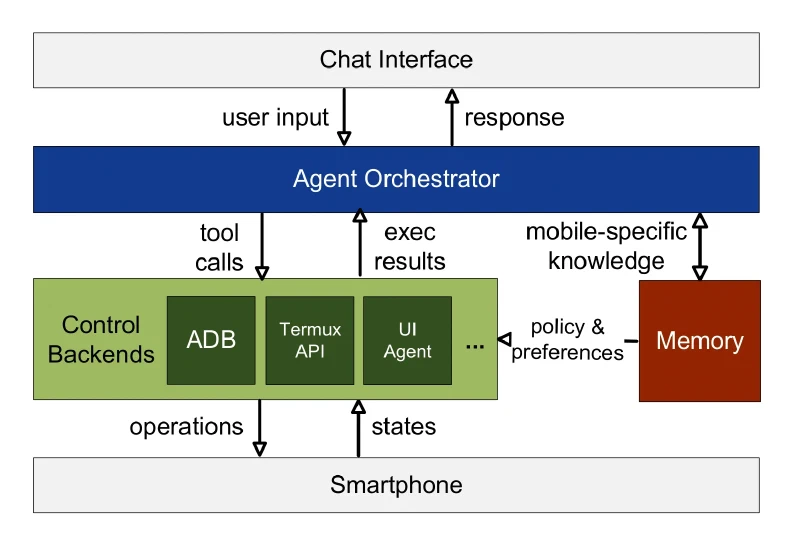
The tests ran on a Google Pixel 9 on Android 16, with DroidRun as the UI agent baseline and a stripped ClawMobile without DroidRun as a second baseline, all three on GPT-5.2 and scored by human annotators. In the authors’ table DroidRun reaches 100 percent on switching the system to dark theme and on playing a YouTube video, 85 percent on posting a YouTube comment, 73 percent on a Chrome search and on a cross-app task that searches football results and writes them into Notes, and 33 percent on installing an app from the Play Store, where ClawMobile scores 100 percent throughout. The authors put the cost of that at 57.5 seconds slower per task on average, with ClawMobile taking 21 seconds for the dark theme switch and 235 seconds for the YouTube comment. Their deterministic-only variant hits the 600-second timeout on both YouTube tasks.
The authors name the remote model as the main open problem, writing that fully remote inference introduces network latency and privacy concerns and calling on-device inference a promising direction they have not taken. They also flag that serialising full UI trees or screenshots into model context can dominate token use and latency on mobile, and present the results as preliminary, six tasks on one device. The code is open source on GitHub, built on the OpenClaw agent framework with a Telegram bot as the chat channel, and the paper was accepted at EuroMLSys 2026 under a Creative Commons Attribution 4.0 license.