Arm recaps Arm Create China and shows Qwen3-TTS 0.6B running on a vivo X300 CPU
Arm has published five developer takeaways from Arm Create, its developer events in Shanghai and Shenzhen. Two of them concern on-device AI. Arm says model choice starts with the workload and not with model size alone, and that developers should decide which parts of an application stay on the device, which run on nearby edge infrastructure and which need the cloud. The Shenzhen panel included Alibaba Qwen, ModelBest, Tencent Hunyuan and Ultralytics.
In the Shanghai keynote, Shantu Roy, Arm’s VP of Developer Relations, discussed the Arm AI Portal. Arm says the portal lists models validated and optimized for Arm-based platforms, together with performance data for specific targets, code and deployment workflows. Coding agents can reach the same information through the Arm MCP Server.
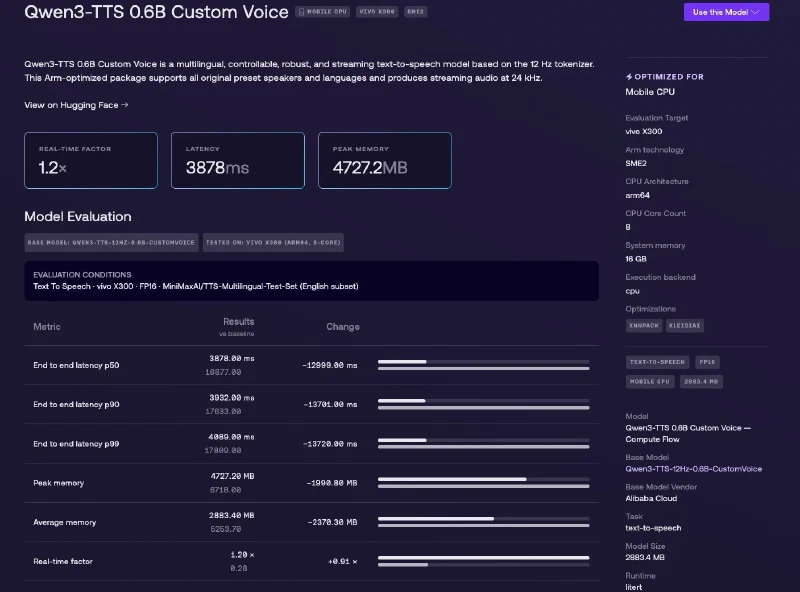
The recap shows the portal’s evaluation of Qwen3-TTS 0.6B Custom Voice, a multilingual streaming text-to-speech model from Alibaba, on a mobile CPU. The entry lists a vivo X300 with 8 CPU cores and 16 GB of memory, SME2, the XNNPACK and KleidiAI optimizations, FP16 weights and the LiteRT runtime. It reports a real-time factor of 1.2x against a baseline of 0.28x and a median end-to-end latency of 3,878 ms against 16,877 ms. Peak memory is 4,727 MB against 6,718 MB, and the evaluation uses the English subset of the MiniMaxAI TTS-Multilingual-Test-Set.
Arm also points to Arm CSS for Mobile 2, which combines the Arm C2 CPU Cluster with SME2 and the Mali G2-Ultra NX GPU. Arm says the platform supports new on-device AI experiences on mobile. The next Arm Create event moves to the US, and Arm has not given a date.