Apple puts the cost of 2-bit compression at 3.4 MMLU points
Apple posted its 2025 foundation models tech report to arXiv on July 17, 2025, giving the numbers behind the roughly 3-billion-parameter on-device model it shipped at WWDC25. The report’s Table 3 puts the price of compressing that model to 2 bits per weight at 3.4 points of MMLU, from 67.8 in 16 bits down to 64.4, with IFEval falling from 85.1 to 82.3.
Apple reaches 2 bits through quantisation-aware training with a learnable scaling factor per weight tensor, and reports that a balanced set of four levels at -1.5, -0.5, 0.5 and 1.5 trains more smoothly than the usual -2, -1, 0 and 1. The embedding table is quantised to 4 bits and the key-value cache to 8 bits, and low-rank adapters are fine-tuned afterwards to claw back the quality the compression costs. The server model takes a different route, compressed after training to 3.56 bits per weight with Adaptive Scalable Texture Compression, a GPU texture format whose fixed-function decode hardware on Apple GPUs unpacks the weights at no cost to the compute cores.
The report also spells out the KV cache sharing the framework announcement only named. Apple splits the transformer so that Block 1 holds 62.5 percent of the layers and Block 2 the remaining 37.5 percent with its key and value projections removed, reusing Block 1’s cache instead. That cuts KV cache memory by 37.5 percent, and because Block 2 produces no keys or values, prefill skips its computation entirely, which Apple says cuts time to first token by about the same 37.5 percent.
Apple rebuilt how the on-device model is trained. The company first trained a dense model on about 14T tokens, sparse-upcycled it into a 64-expert mixture-of-experts version, where only part of the model runs per token, using 1T high-quality tokens, then retrained the dense model on its last 10 percent of tokens against a distillation loss from that MoE teacher. Apple states this cut the cost of training the teacher by 90 percent and removed the need for structural pruning. The server model was trained on 8192 v5p Cloud TPU chips for 13.4T tokens.
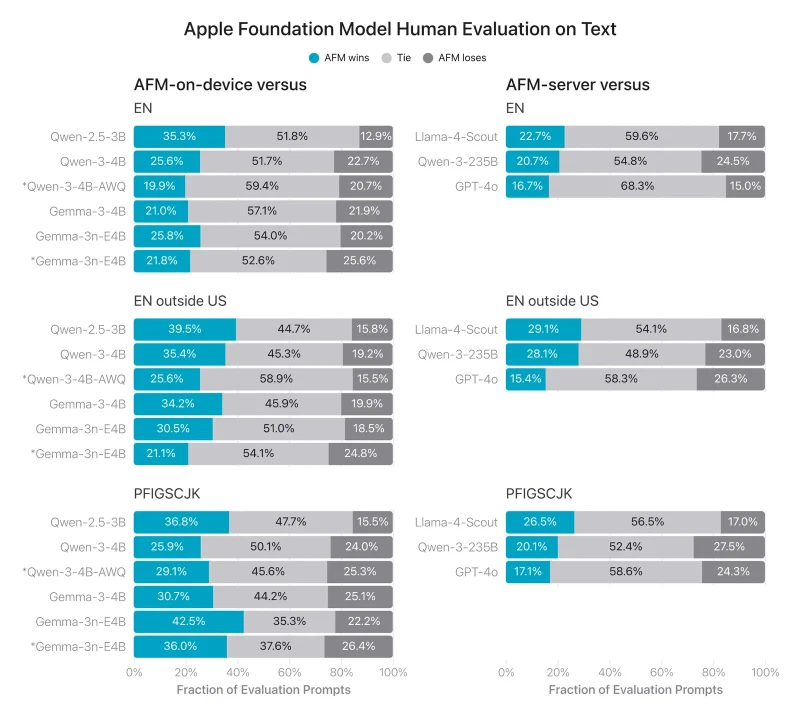
For the language expansion the report states the models are designed to support 16 languages, built on a text tokenizer grown from a 100k to a 150k vocabulary and a continued pre-training mix whose multilingual share rose from 8 percent to 30 percent. In Apple’s own human evaluation on US English text prompts, graders preferred the on-device model over Qwen-2.5-3B on 35.3 percent of prompts against 12.9 percent the other way, while against Gemma-3-4B the split was 21.0 percent to 21.9 percent. The report is on arXiv under a Creative Commons Attribution 4.0 license.