Mobile AI news ticker

Tuesday 30 April 2024

ExecuTorch alpha runs Llama 2 7B on iPhone 15 Pro and Galaxy phones

PyTorch released ExecuTorch alpha on April 30, 2024, the first version of its edge runtime aimed at large language models rather than small vision and speech networks. PyTorch says the work enables Llama 2 7B to run on iPhone 15 Pro, iPhone 15 Pro Max and Samsung Galaxy S22, S23 and S24 phones, with early support for Llama 3 8B. The example project shipped with the release reports 8.15 to 11.6 tok/s for the quantised 7B model, measured by PyTorch over adb on a Galaxy S22, a Galaxy S24 and a OnePlus 12. The 0.1 preview from October 2023 had no such path.

Fitting a 7B model on a phone came down to quantisation. Every linear layer carries 4-bit weights in groups of 128 or 256 values, with activations quantised to 8-bit at runtime from their observed range. PyTorch measured WikiText perplexity at 9.16 for the full-precision model against 10.2 and 10.7 for the two group sizes, and notes that groups smaller than 128 were not enabled because the resulting files were still too large, since the embedding table and the weight scales remained in 32-bit floats. Support for 16-bit floats was under way.

Arm, Apple and Qualcomm Technologies worked on the release, and PyTorch describes the mobile accelerator paths through Core ML, MPS, TOSA and the Qualcomm AI Stack as ongoing work rather than finished. The release notes add Snapdragon 8 Gen 3 support and 4-bit and 16-bit quantisation on the Qualcomm side, over 100 operators on Apple’s MPS backend, and a Vulkan delegate for mobile GPUs. PyTorch also credits Google for joint work on XNNPACK, the CPU library that carried the language model numbers, and says MediaTek was enabling the Llama models on its own chips.

PyTorch was explicit about what alpha did not yet do. The release notes mark XNNPACK as the only finished performance path for generative models and everything else as in progress, and the announcement calls on-device LLM support early while asking the community for help building GPU and NPU delegates and expanding the quantisation schemes. Meta was already shipping the runtime elsewhere, using it for hand tracking on Quest 3, for several models on the Ray-Ban Meta smart glasses and in a beginning rollout inside Instagram. The Python package became installable from PyPI with this release.
Tuesday 23 April 2024

Apple releases OpenELM at 270M to 3B, with parameters spread unevenly across layers

Apple posted OpenELM to arXiv on April 22, 2024, a family of four language models at 270M, 450M, 1.1B and 3B parameters, each also released in an instruction-tuned version. The name stands for Open-source Efficient Language Models, and the efficiency comes from layer-wise scaling, which spreads the parameter budget unevenly across the transformer’s layers instead of giving every layer the same shape. Table 1 of the paper gives the 1.1B model an average of 45.93% across the OpenLLM leaderboard tasks against 43.57% for OLMo 1.2B, a gap the authors state as 2.36%, reached on 1.5T pre-training tokens against OLMo’s 3.0T.

Layer-wise scaling varies the number of attention heads and the width of the feed-forward network from layer to layer, keeping layers near the input narrower and widening them towards the output, so a layer late in the stack holds more parameters than an early one. Apple trained the four variants for 350k iterations with its CoreNet library on public data only, drawing on RefinedWeb, a deduplicated PILE, a subset of RedPajama and a subset of Dolma v1.6, about 1.8T tokens in total. Text is filtered and tokenised on the fly rather than pre-tokenised, using the same tokeniser as Llama.

The paper benchmarks the models on an Apple MacBook Pro with an M2 Max chip and 64 GiB of RAM running macOS 14.4.1, through a port of OpenELM to MLX v0.10.0, and separately on a Linux workstation with an Intel i9-13900KF and an NVIDIA RTX 4090. On the MacBook in BFloat16, Apple measures the 270M model generating 212.40 tok/s and the 3B model 33.96 tok/s, with the 4-bit versions at 256.35 and 60.33 tok/s. On the CUDA machine OpenELM 1.08B is slower than OLMo 1.18B, at 92.15 tok/s against 203.40, which the authors attribute to a naive RMSNorm implementation and to OpenELM having 113 normalisation layers where OLMo has 33.

Apple presents the release as the complete framework rather than weights and inference code, covering the training and evaluation code for public datasets, the training logs, multiple checkpoints, the pre-training configurations and the code that converts a model to MLX for inference and fine-tuning on Apple devices, with pre-converted bf16 and 4-bit checkpoints for all four sizes. The eight models are on Hugging Face and the code is in CoreNet. Both the model cards and CoreNet name the terms as the Apple sample code license, which is Apple’s own license and not one of the standard open source licenses.

Monday 22 April 2024

Microsoft runs Phi-3-mini offline on an iPhone 14 at over 12 tokens per second

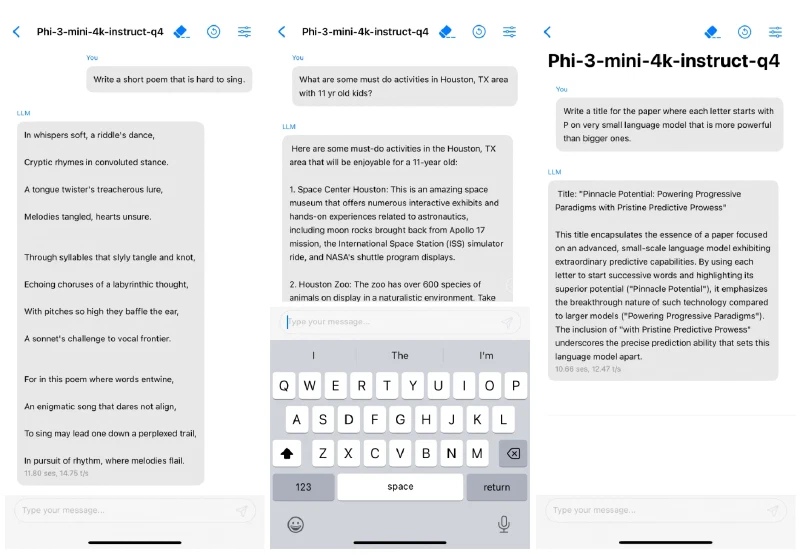
Microsoft introduced Phi-3-mini on April 22, 2024, a 3.8-billion-parameter model trained on 3.3 trillion tokens. The technical report puts it at 69 percent on MMLU and 8.38 on MT-bench, which the authors say rivals models such as Mixtral 8x7B and GPT-3.5.

Quantised to 4 bits the model occupies about 1.8 GB, small enough for a phone. The report describes the test directly.

We tested the quantized model by deploying phi-3-mini on iPhone 14 with A16 Bionic chip running natively on-device and fully offline achieving more than 12 tokens per second.

Three iPhone screenshots of a chat app labelled Phi-3-mini-4k-instruct-q4 answering prompts, with timings of 11.80 seconds at 14.75 tokens per second and 10.66 seconds at 12.47 tokens per second
Screenshots: Microsoft, Figure 1 of the technical report.

The same report covers two larger siblings, Phi-3-small at 7B parameters and Phi-3-medium at 14B, both trained on 4.8 trillion tokens. Microsoft reports 75 percent on MMLU for the small model and 78 percent for the medium one.

Wednesday 17 April 2024

Octopus v3 picks an action from an image and a query in under 1B parameters

Wei Chen and Zhiyuan Li posted Octopus v3 on April 17, 2024, a technical report on a multimodal agent model that takes an image alongside a text query and answers with a function call. The model has fewer than 1B parameters, handles English and Chinese in one set of weights, and is built to run on edge devices. The paper lists both authors at Stanford University and gives a Nexa AI address for correspondence.

The model encodes each supported function as a single functional token in its vocabulary, learned the way a language model learns an unfamiliar word from the contexts it appears in, so the output is one token for the action plus its arguments and needs no parser to read. Images run through a CLIP-based encoder, which the authors say they chose after comparing encoding methods. Training runs in stages, with the language model and the image encoder trained apart, then merged and aligned, then taught the functional tokens using the method from Octopus v2, and finally tuned by reinforcement learning with another large language model acting as the reward model.

The evaluation consists of 10 smartphone functions converted into functional tokens and ten worked examples, each printing the model’s output next to the output of GPT-4V feeding GPT-4, which the authors prompted with all the function descriptions and a few examples. The authors write that their model performs comparably to that pair on the selected functions. The report carries no accuracy rate, no success rate and no benchmark table, so the comparison rests on the ten printed generations rather than on a measured score.

The report states that the model runs on devices as constrained as a Raspberry Pi and that it makes converting a Raspberry Pi into something like a Rabbit R1 or a Humane AI Pin practical with an on-device model instead of a cloud service. It names no Raspberry Pi board, no phone and no other hardware it was run on, and gives no latency, no memory footprint and no throughput, so the edge deployment is asserted rather than shown. The authors do name one cost themselves, writing that vision input may introduce considerable latency and that they were optimising inference speed.

Weights and inference code were available only on application when the report went up, which describes the model as still under testing and for research purposes only, and the authors state that the functional token is licensed. The project page that hosted the demo videos no longer resolves. The authors list audio and video as the modalities they want to support next.

Tuesday 2 April 2024

Octopus v2 is a 2B model that calls Android APIs with one token per function

Wei Chen and Zhiyuan Li published Octopus v2 on April 2, 2024, a 2B function-calling model fine-tuned from Google’s Gemma 2B that turns a spoken or typed request into an Android API call. On their own evaluation set built from 20 Android APIs, the authors report 99.524% accuracy and 0.38 seconds per call for Octopus v2, against 98.571% and 1.02 seconds for GPT-4. Both authors give Stanford University as their affiliation on the paper and publish the weights under the name Nexa AI.

The distinguishing idea is what the authors call a functional token. Each of the 20 APIs gets its own special token added to the tokenizer and to the model’s output head, so picking a function becomes a single choice among 20 token candidates instead of writing the function name out as text and hoping every piece of it lands correctly. Since the model learned during fine-tuning what each of those tokens stands for, the function descriptions no longer have to sit in the prompt, which the paper puts at over 95% less context. Retrieval-augmented function calling processes roughly 1,000 tokens per call in their comparison, while Octopus v2 sees the query alone, typically under 30 tokens.

Shorter context is also where the speed comes from. The authors measure Llama-7B with retrieval-augmented function calling at 68.095% accuracy and 13.46 seconds per call on a single NVIDIA A100, and Octopus v2 at 0.38 seconds under the same settings on the same A100, a 35-fold difference. The phone figure is a separate measurement. With the model quantised and the state for the fixed prompt prefix precomputed, they report a function call finishing in 1.1 to 1.7 seconds for queries of 20 to 30 tokens on what the paper calls a standard Android phone, without naming the device, and they estimate 37 times more calls per iPhone battery charge than a 7B model with retrieval.

The authors name limits of their own result. Training with LoRA instead of the full model drops accuracy to 99.048%, and cutting the training set from 1,000 to 100 generated examples per API drops it to 98.095%, which they still put forward as the low end of a usable range. The set of callable functions is fixed at training time, since every API has to exist as a token before the model can emit it, and they price the data generation at 0.0224 USD per 1,000 examples per API. They also note that the GPT-3.5 and GPT-4 latencies were taken through OpenAI’s API on March 18, 2024, and may reflect API traffic or hardware allocation at that moment.

Nexa AI released the weights on Hugging Face under a non-commercial CC BY-NC 4.0 license, on top of Google’s Gemma 2B. The model card said at the time that the team was still preparing the code for an open-source release.

Octopus fine-tunes a 2B model to 93 percent on API function calls

Wei Chen, Zhiyuan Li and Mingyuan Ma of Stanford University and Harvard University posted Octopus on April 2, 2024, four open models fine-tuned to pick the right software API for a request and fill in its arguments. On a benchmark the authors built themselves, they report their fine-tuned Gemma 2B answering 93 percent of calls correctly against 96 percent for GPT-4 and 50 percent for GPT-3.5, with the CodeLlama 7B and Gemma 7B versions reaching 97 percent once an output filter is switched on.

The title says on-device, but nothing in the paper runs on a device. The authors fine-tuned the models on A100 80GB GPUs and queried GPT-4 and GPT-3.5 through OpenAI’s API, so every number was measured server-side. The device claim is a single sentence stating that models of this size can already be deployed on mobile, pointing at MLC LLM, and the paper names no phone, no chip and no latency, memory or throughput figure.

The training set starts from roughly 30,000 of the most used APIs on RapidAPI Hub, which GPT-4 cut to about 20,000 by dropping entries with missing arguments or descriptions that did not match their parameters. The authors rewrote each API as a Python function signature with a docstring, had GPT-4 write five answerable queries per API and an equal share of unanswerable ones, and let GPT-4 verify the result, ending at about 150,000 examples as described in the paper. Vector search over the function descriptions pulled in near-identical functions as distractors, and training worked through them from easy to hard.

Base models were CodeLlama 7B, Gemma 2B and 7B and Stable Code 3B, all tuned with LoRA at rank 16 and 8-bit quantisation, using 90 GPU hours for CodeLlama 7B and Gemma 7B, 60 for Stable Code 3B and 30 for Gemma 2B. The output filter the authors call a conditional mask blocks, at each generated token, anything that would break the expected format, so a function name has to come from the known list and an argument has to match its declared type. The authors state that it cannot be applied to GPT-4 or GPT-3.5 because the OpenAI API does not return the underlying token scores, and that GPT-3.5 was not counted wrong for formatting mistakes.

The paper states that the training dataset and the fine-tuned models will be open sourced soon, and names no repository or date. The preprint went up under a Creative Commons Attribution-NonCommercial-ShareAlike 4.0 license.

Monday 18 March 2024

One shared on-device LLM keeps a context per app and switches in 0.27 seconds

Researchers at Peking University, the Beijing University of Posts and Telecommunications and Tsinghua University published LLMS on March 18, 2024, an operating system service that keeps a separate conversation context for every app calling one shared on-device language model. Serving eight active contexts of Llama2-7B on a Jetson Orin NX, the authors measure 0.27 seconds to switch to another app’s context. They report switches up to 20 times and on average 9.7 times faster than a baseline that swaps the same chunks but quantises every one to 8 bits, modelled on the server system vLLM.

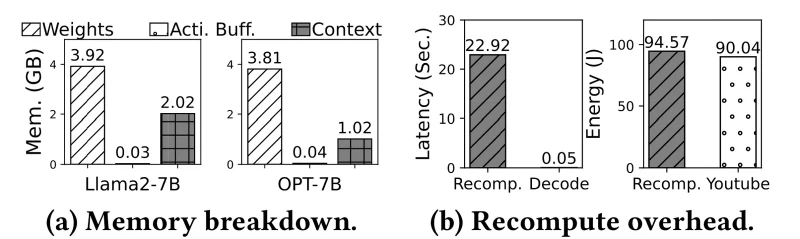
The premise is one model held by the operating system instead of a copy inside each app, the way Android AICore serves Google apps, with every caller keeping its own KV cache, the stored attention state that lets a model continue a conversation without rereading it. On a Xiaomi 14 running llama.cpp, the authors measure one Llama2-7B context at the full 4k-token window at 2.02 GB, against 3.92 GB for the 4-bit weights, so a few apps holding contexts outweigh the model they all share. Letting the phone’s low-memory killer reclaim that memory means rebuilding the context by running the text through the model again, which the authors put at 22.92 seconds and 94.57 J on the same phone, close to the 90.04 J they measure for one minute of YouTube.

What moves to storage is the KV cache, cut into chunks of 16 tokens, while the prompt and output text stay resident. The service quantises each chunk to 8, 4 or 2 bits according to how much attention its tokens draw from the rest of the context, holding a 50 percent average set by the system, then refills a context by reading some chunks from disk while recomputing others from the stored text and overlapping the two. The authors report twice the compression ratio of static quantisation at negligible accuracy loss, where compressing every chunk alike to 4 bits or 2 bits costs up to 59 percent and 99 percent of accuracy.

Each of the three techniques carries part of that 0.27 seconds, which the authors break down as 0.42 seconds without the per-chunk compression, 0.62 seconds without the eviction order and 1.62 seconds without the read-and-recompute pipeline. The prototype is 3.5k lines of Python and C++ on Hugging Face Transformers and mllm, run on a Jetson Orin NX, a Jetson TX2 and a Xiaomi 14 with a Snapdragon 8 Gen 3, each with 8 GB of RAM, using Llama2-7B and OPT-6.7B over 72-hour traces synthesised from six datasets, and the authors state that it leaves token generation speed within 5 percent of running without it. The paper is on arXiv under a CC BY 4.0 license, and the same four authors published the work at SenSys 2026 in Saint-Malo in May 2026 as An Efficient Context Management System for On-Device LLMaaS.

Two chart groups for a Xiaomi 14, memory for Llama2-7B split into 3.92 GB of weights, 0.03 GB of activation buffers and 2.02 GB for one context, with OPT-7B at 3.81, 0.04 and 1.02 GB, and recompute cost at 22.92 seconds against 0.05 seconds to decode a token and 94.57 J against 90.04 J for a minute of YouTube
Charts: Yin et al. Measured on a Xiaomi 14, with the memory breakdown taken on llama.cpp.

Thursday 7 March 2024

Google ships an experimental MediaPipe LLM Inference API for web, Android and iOS

Google released the MediaPipe LLM Inference API on March 7, 2024, an experimental way to run language models fully on device from web, Android and iOS apps. Four open models are supported at launch, Gemma 2B, Phi 2, Falcon 1B and Stable LM 3B.

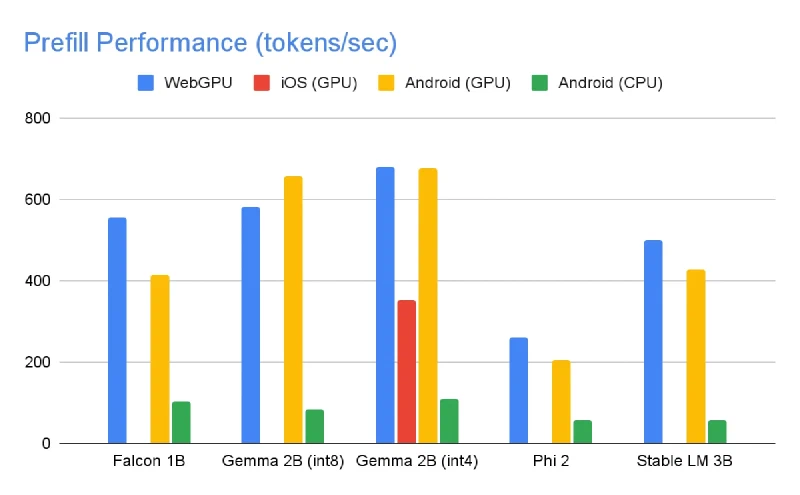
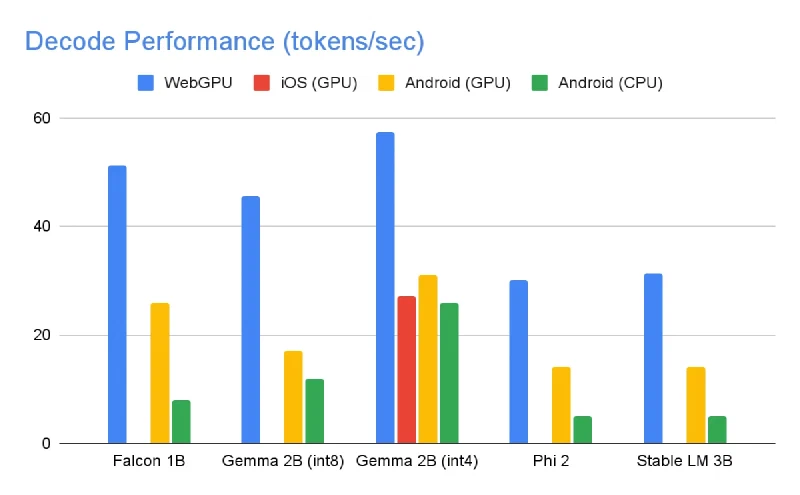
The API quantises weights to int8, with Gemma 2B using mixed 4-bit and 8-bit weights. Google measured throughput on unnamed high-end devices with a 1024-token input prompt and a maximum of 1280 tokens. In its charts, Gemma 2B at int4 prefills at roughly 680 tokens per second on WebGPU and on an Android GPU, and decodes at about 57 tokens per second on WebGPU against 31 on an Android GPU and 27 on iOS.

Bar chart of prefill speed in tokens per second for Falcon 1B, Gemma 2B at int8 and int4, Phi 2 and Stable LM 3B across WebGPU, iOS GPU, Android GPU and Android CPU
Chart: Google.
Bar chart of decode speed in tokens per second for the same five models and four runtimes, topping out near 57 tokens per second for Gemma 2B at int4 on WebGPU
Chart: Google. Gemma 2B at int4 was the only model that ran on iOS.

Google marks the Android version as intended for experimental and research use only, and points production apps to the Gemini API or to Gemini Nano through Android AICore instead. On iOS, Gemma 2B at int4 was the only model the team could run, which Google attributes to the memory available on the platform.

Wednesday 28 February 2024

MeRino designs sub-100M language models that run 4.9 times faster than OPT-350M

Researchers at the University of Central Florida and the University of Technology Sydney published MeRino on February 28, 2024, a method that draws up a transformer architecture to fit a given device’s limits on parameters, arithmetic and latency, instead of shrinking an existing model to fit. Their largest design, MeRino-64M, reaches the same 0.408 average accuracy across twelve zero-shot tasks as Meta’s OPT-350M while carrying 64M parameters against 331M. The authors time it at 114 ms against 559 ms for a 128-token input on an NVIDIA Jetson Nano, or 4.9 times faster.

The search scores a candidate architecture without ever training it. Each candidate shape, meaning how many blocks it has and how wide and how deep each block is, gets a single number that the authors compute from the dimensions of its attention and feedforward matrices and treat as a measure of how much information the network can represent, with a second term that penalises shapes which are deep and narrow, because those train badly. An evolutionary algorithm mutates block widths and depths for 100,000 rounds, discards everything that breaks the budget, keeps the highest-scoring survivors and returns the best one. A precomputed lookup table stands in for the matrix decomposition the score would otherwise need, and the authors put its average error at 0.03 percent.

Because the score is arithmetic over an architecture’s dimensions rather than a forward pass, the search runs on the target board itself. The paper puts one MeRino search at 0.05 hours and 0.75 Wh on the Jetson Nano’s CPU, against 1.2 hours and 300 Wh for the TE-NAS architecture search on an NVIDIA GTX 1080Ti. Every device measurement in the paper comes from that Jetson Nano developer board, taken at batch size 1 and sequence length 128 and averaged over 16 runs, and the authors report no measurements on phones or tablets. Training the designed models is separate and conventional work, at 600,000 steps on 8 NVIDIA H100 GPUs.

The same tables show MeRino-64M behind OPT-350M on language modelling, at 22.47 against 18.51 perplexity on WikiText-2 and 27.06 against 23.08 on Penn Treebank, where lower is better. The smallest design, MeRino-52M, matches Pythia-70M at 0.383 average zero-shot accuracy and 48 ms against 95 ms. The authors state that the weights and evaluation for Meta’s MobileLLM were not released when they submitted, so they do not compare against it, and they report that 8-bit weight quantisation leaves accuracy almost unchanged while 4-bit costs about 1 percent. The work was accepted at AAAI 2025 and the paper names no code release.

Tuesday 27 February 2024

Stability AI trains Stable LM 2 1.6B on seven languages and 2 trillion tokens

Stability AI published the Stable LM 2 1.6B technical report on February 27, 2024, describing a decoder-only model of 1.6B parameters trained from scratch on roughly 2 trillion tokens of public data. The mix is multilingual by design, with web text in German, Spanish, French, Italian, Dutch and Portuguese alongside English, and the report states the finished model handles all seven. The model has 24 layers and a context length of 4096 tokens, which the authors list as one of the things they want to extend.

In the report’s multilingual table, which averages translated versions of four English benchmarks and a next-word prediction set across those seven languages, the base model scores 40.5, above Google’s Gemma 2B at 39.8 with 2.5B parameters and Microsoft’s Phi-2 at 34.6 with 2.7B. The chat variant reaches 41.5 and Stability’s own 3B model 41.7. The authors state they used no multilingual data during fine-tuning, so the language coverage comes out of pre-training alone.

On the six English tasks of the Hugging Face Open LLM Leaderboard, the same report’s table puts the base model at an average of 45.3, behind Alibaba’s Qwen 1.5 1.8B at 46.6 and Gemma 2B at 46.5. The instruction-tuned StableLM 2 Zephyr 1.6B averages 49.7, the highest of the sub-2B entries in that table, ahead of Phi-1.5 at 47.7 and behind the 2.7B Phi-2 at 61.3. The report’s abstract calls Stable LM 2 1.6B the state-of-the-art open model under 2B parameters at the time of publication.

Stability built the Zephyr variant in three stages. It fine-tuned the base model on seven public instruction datasets, 826,938 samples after dropping conversations longer than eight turns, then aligned the result with direct preference optimisation, which trains on pairs of preferred and rejected answers, using UltraFeedback and Intel’s Orca Pairs and borrowing most hyperparameters from the recipe behind Hugging Face’s Zephyr 7B. A third stage taught the model who made it and what a language model cannot do, using 10,000 opening messages the base model wrote for itself. The variant scores 5.42 on MT-Bench, where a larger model judges answers to open-ended questions, above Qwen 1.5 1.8B Chat at 5.29 and Gemma 2B Instruct at 5.19 and below Stability’s own StableLM Zephyr 3B at 6.64.

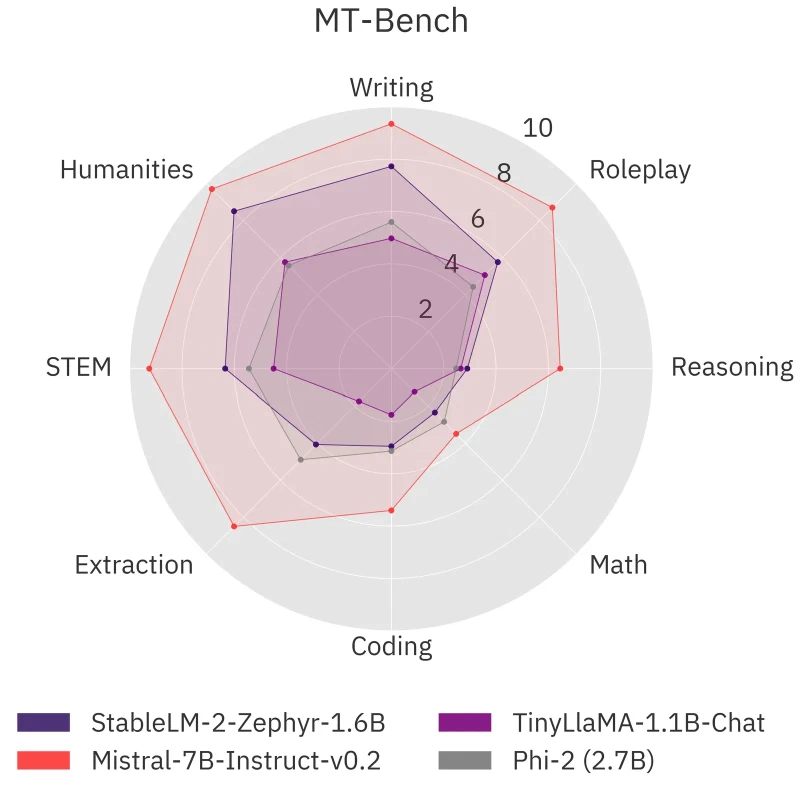
Radar chart of eight MT-Bench categories comparing StableLM-2-Zephyr-1.6B, Mistral-7B-Instruct-v0.2, TinyLlaMA-1.1B-Chat and Phi-2, with Mistral widest on every axis and the 1.6B model ahead of Phi-2 on writing, humanities and roleplay but behind it on coding and extraction
Chart: Bellagente et al., the authors' own figures.

Stability put both sets of weights on Hugging Face along with quantised builds for llama.cpp, Apple’s MLX and Intel’s OpenVINO. The report measures 127 tok/s at 11 W for the 4-bit MLX build on an M2 Mac mini with 8 GB, against 71 tok/s at 6 W in FP16, and 99 tok/s for a 4-bit GGUF build on a 2023 MacBook Pro with 16 GB, while stating these figures are meant as a practical reference rather than rigorous benchmarking. Neither release is open source. The report says the model ships under a non-commercial licence, the Zephyr model card names the Stability AI Non-Commercial Research Community License and points commercial users to the company, and the base model card now carries the Stability AI Community License with commercial use running through a Stability membership.

BitNet b1.58 gives every weight three values and runs 3B in 2.22 GB

Microsoft Research and the University of Chinese Academy of Sciences published BitNet b1.58 on February 27, 2024, a language model in which every single weight is one of three values, -1, 0 or 1. At 3B parameters the authors measure it at 2.22 GB of memory against 7.89 GB for a full-precision Llama-style model of the same size trained on the same number of tokens, a 3.55 times reduction, with a slightly lower perplexity of 9.91 against 10.04.

Three possible values need log2(3) bits to store, which is roughly 1.58 and where the name comes from. What that buys is a change to the matrix multiplication that dominates the work of running a model. A normal model multiplies each weight by an activation in floating point and sums the products, but multiplying by -1, 0 or 1 is only a sign flip, a skip or a copy, so the paper states that the matrix multiplication of BitNet “only involves integer addition”. Activations stay at 8 bits.

The models are trained from scratch at this precision rather than trained in full precision and squeezed down afterwards, which is how most low-bit models on phones are produced today. The authors trained BitNet b1.58 and their own reproduced Llama baseline on the same data for the same number of tokens at each size, and compare the two directly. They report that BitNet b1.58 starts to match the full-precision baseline in perplexity at 3B and on zero-shot end tasks from 3B as well, where it averages 50.2 against 49.7.

The efficiency figures widen with size. Memory drops 2.60 times at 700M, 2.93 times at 1.3B and 3.55 times at 3B, and latency per output token falls 1.23 times, 1.67 times and 2.71 times across the same three sizes. For throughput the authors ran 70B models on two A100 cards and report a batch size of 176 against 16 and 2977 tokens per second against 333, an 8.9 times gain. They also calculate that on 7nm chips the arithmetic for matrix multiplication costs 71.4 times less energy, because integer addition is far cheaper than floating-point multiply-accumulate.

The paper names no model release and its arXiv listing marks it as work in progress. The authors argue the approach suits CPUs, “which are the main processors used in edge and mobile devices”, and say the lower memory and energy cost is what would let such models run there. They close by calling for new hardware and systems designed specifically for 1-bit models.

Update, April 16, 2025. Microsoft released BitNet b1.58 2B4T, a 2B model trained from scratch on 4 trillion tokens at ternary precision, which the team calls the first open-source native 1-bit model at that scale. The report puts its non-embedding memory at 0.4 GB against 1.4 GB for Gemma-3 1B and 2.6 GB for Qwen2.5 1.5B, measures CPU decoding at 29 ms per token on a 13th Gen Intel Core i7-13800H using 8 threads against 41 ms and 65 ms for the same two models, and estimates energy at 0.028 J against 0.186 J and 0.347 J. Across the benchmark suite it averages 54.19, above Llama 3.2 1B at 44.90 and just under Qwen2.5 1.5B at 55.23. The weights are on Hugging Face, with a custom CUDA kernel for GPUs and CPU inference through bitnet.cpp, the runtime Microsoft published in October 2024 and measured at 2.37 to 6.17 times faster than the baseline on x86 CPUs and 1.37 to 5.07 times faster on ARM.

Monday 26 February 2024

MobiLlama is a fully transparent 0.5B model that runs in 770 MB on a phone

Researchers at MBZUAI published MobiLlama on February 26, 2024, a language model of 0.5B parameters aimed at devices that cannot host a large one. The stated aim is a fully transparent small model rather than open weights alone, so the authors release the complete pre-training data pipeline, the training and evaluation code, the weights and more than 300 intermediate checkpoints. They also derive a 0.8B version from the same design.

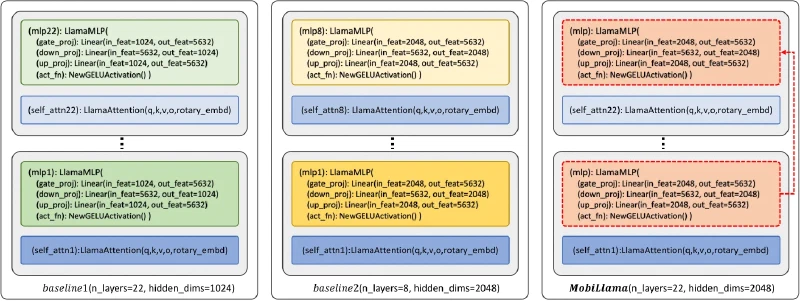
The design point is a single feed-forward block shared by every transformer layer. Each transformer block normally carries its own feed-forward network, the part that reworks each token’s representation after attention, and the authors measure those layers as 65% of all trainable parameters in their 1.2B reference model. Reusing one block across all 22 layers cuts trainable parameters by 60%, from 1.2B to 0.52B, while keeping the 22 layers and the hidden size of 2048 that the reference model has. The authors report pre-training the shared version in 7 days and 26.6K A100 GPU hours, against 12 days and 46.1K hours for the unshared 1.2B model.

Three side-by-side transformer stacks, the two baselines giving every block its own MLP module and MobiLlama routing all blocks to one shared MLP marked in red
Diagram: Thawakar et al.

For deployment the authors measured a smartphone with a Snapdragon 685, a laptop with an i7 CPU and a desktop with an RTX 2080 Ti, using 4-bit GGUF builds on the phone and the laptop. On the phone they put MobiLlama 0.5B at 770 MB of RAM and 7.02 tok/s, drawing 5.32 mAh per 1,000 tokens at 13.02% CPU utilisation. They measured Llama 2 7B on the same phone at 4287 MB, 1.19 tok/s and 10.07 mAh per 1,000 tokens with 77.41% CPU utilisation, and Phi-2 2.7B at 1893 MB and 2.88 tok/s. On the laptop CPU the 0.5B model reaches 36.32 tok/s in 799 MB.

MobiLlama 0.5B averages 46.00 across nine benchmarks from the Open LLM Leaderboard in the authors’ own evaluation, which they compare with 43.57 for pythia-410m, and the 0.8B version, made by widening the shared block, averages 46.67. The models were pre-trained on 1.2T tokens from the Amber dataset of LLM360, where the two largest parts are a curated web crawl and code. Weights and chat-tuned variants are on Hugging Face under Apache 2.0, and the repository carries the training code and an Android app package for running the model on a phone.