Gemini Intelligence is coming to the Pixel Watch 5, 9to5Google reports. According to the report, offline Gemini commands on the watch use a separate on-device model when the phone or an internet connection is unavailable. Those commands cover timers and alarms, brightness and modes, music control, opening apps and starting workouts.
On-device smart replies now offer three responses instead of one, which the report attributes to a Gemini Nano upgrade that makes them 50 percent faster.
Other parts of the feature set depend on a connection. Proactive Suggestions, formerly Magic Cue, are generated on a paired Pixel 11 and bridged to the watch, and Personal Intelligence draws on Gmail, Calendar and Keep. The update also brings a new At a Glance space on the watch face for timers, workouts, music, flight details and navigation.
Google has announced the Pixel 11, Pixel 11 Pro and Pixel 11 Pro XL, built around the Tensor G6 chip. Google states that Tensor G6 packs 50 percent more TPU compute and, paired with the latest Gemini Nano model, processes on-device AI tasks up to 3.5 times faster while using up to 3.5 times less energy.
The company also cites an upgraded CPU with 25 percent faster web browsing and 15 percent quicker app launches, and says the chip powers the 30x Super Zoom on the 5x telephoto lens. Google does not publish RAM figures, model sizes or per-task latency in the announcement.
Pre-orders opened on 12 August, with retail availability from 20 August.
▶Meet Google Pixel 11 Pro
Loading connects your browser to www.youtube-nocookie.com, which may process your IP address and use cookies.
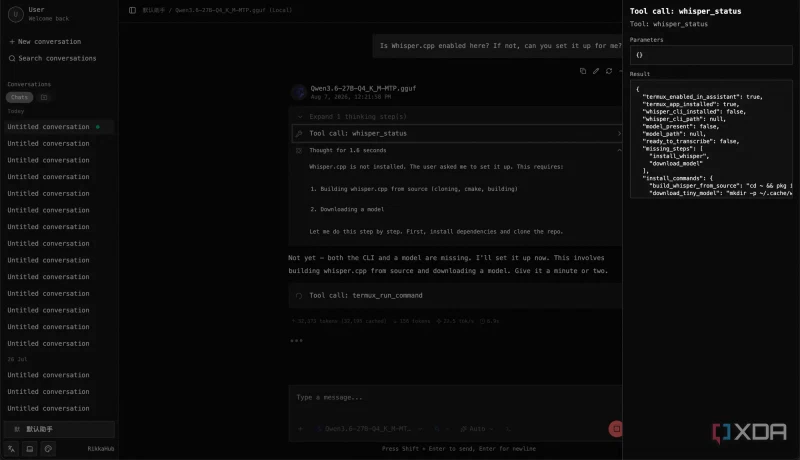
Adam Conway at XDA has testedRikkaHub Agent, a fork by ExTV of the open-source Android LLM client RikkaHub, which adds an agent layer with more than 80 device tools. The phone runs the agent loop and executes the tools; the model itself runs elsewhere on the local network over an OpenAI-compatible endpoint.
The test device was an Oppo Find N5 with a Snapdragon 8 Elite and 16 GB of RAM. Inference ran on a Radeon RX 7900 XTX with Qwen 3.6 27B at Q4_K_M, roughly 16 GB, at 40 to 50 tokens per second. A second configuration used Qwen 3.6 35B on a Lenovo ThinkStation PGX with Nvidia’s GB10 Grace Blackwell.
Screenshot: XDA.
The tool set covers tapping, swiping, scrolling and typing on screen, reading notifications, sending SMS, file management, browser control, SSH, scheduled jobs, a JavaScript runtime and Telegram. All tools are off by default and enabled per assistant, actions with side effects require approval, and a deterministic blocklist rejects destructive commands. The default context is 7,000 input tokens, rising to 32,000 with every tool enabled.
Asked whether whisper.cpp was installed, the agent determined that neither the command-line tool nor a model was present, requested permission, then installed the dependencies, cloned the repository and compiled it inside Termux. The build took seven minutes, and the agent chose the 75 MB small model on speed and accuracy grounds. It then transcribed a Telegram voice message, installing ffmpeg, converting the OGG/Opus file to 16 kHz mono WAV and returning a transcript in about two seconds.
Running the model on the phone itself was slower. With Gemma 4 E2B, a 2.6 GB build accelerated by LiteRT-LM, Conway reports chat worked but agentic tasks were painful, and tool calls were emitted as plain text until an update fixed the behaviour.
Frontier intelligence is never what I’d want from a phone agent, which is why a local LLM works perfectly.
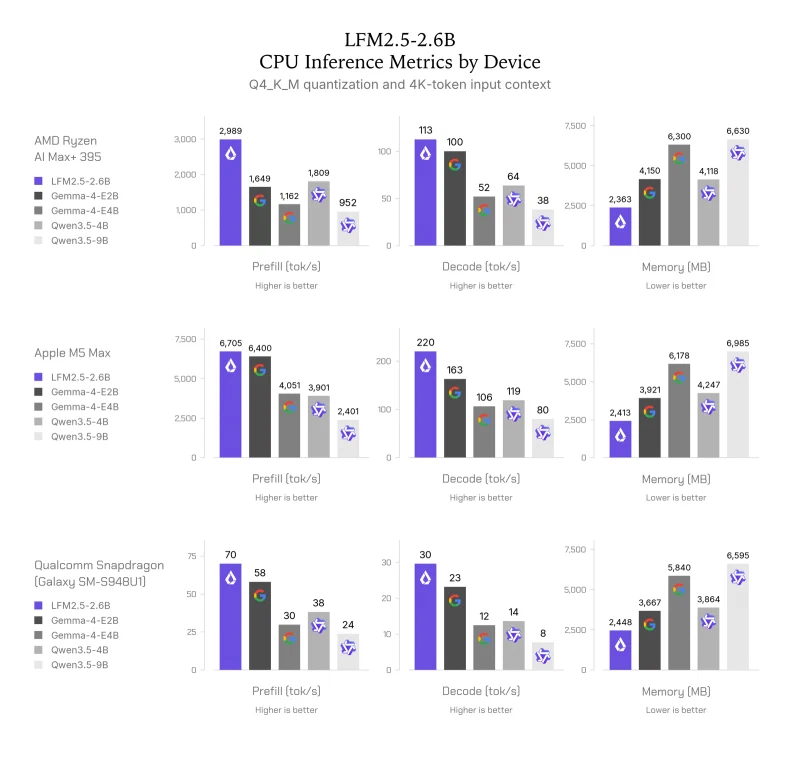
Liquid AI has releasedLFM2.5-2.6B, a 2.6-billion-parameter model built on its LFM2 architecture for edge deployment. The company reports 30 tokens per second on a phone, with CPU inference staying under 2.5 GB of memory. Its published chart identifies the device as a Qualcomm Snapdragon Galaxy (SM-S948U1) and puts memory use at 2,448 MB at Q4_K_M quantisation with a 4K-token input context.
Chart: Liquid AI.
On other CPUs Liquid AI cites 220 tokens per second on an M5 Max and 113 tokens per second on a Ryzen AI Max+ 395. The model was pre-trained on roughly 34 trillion tokens, uses a 128K vocabulary, and its mid-training included a dedicated 128K context-extension phase.
Liquid AI positions the model for agentic use, describing planning, tool calling and multi-step tasks, and states that it is competitive with, and often outperforms, models nearly four times its size on instruction-following and tool use, while larger models keep an advantage in coding. Weights are on Hugging Face in BF16, GGUF for llama.cpp, and ONNX.
Google’s Android developer blog states that Samsung’s new foldable devices come with Gemini Nano 4, which it calls its latest on-device model. The post credits Nano 4 with support for more than 140 languages and better multimodal understanding.
Apps reach the model through ML Kit’s Prompt API, which sends natural language requests on-device to Gemini Nano. It takes text, or a combination of image and text, and returns text or structured output. Google names structured output and thinking mode as the features to use for on-device intelligence.
The ML Kit release notes dated 14 July 2026 record the structured output API, system instructions and thinking mode arriving in the Prompt API, along with multi-image support and an output token limit raised to 4,096 tokens. A note dated 21 July records a fix for Gemini Nano v4 compatibility in the Prompt API on non-Pixel devices. The Prompt API moved from alpha to beta in January 2026 and carries no service level agreement or deprecation policy.
The post also points developers to app functions, which share an app’s capabilities with the Gemini Intelligence system. Its remaining sections cover adaptive layouts, fold-aware design, CameraX and Wear OS widgets.
Researchers at the University of Macau, the University of Georgia and the Hong Kong University of Science and Technology published FBLayout on July 7, 2026, a system that fine-tunes transformer models on a phone’s own GPU, accepted at ACM MobiSys 2026. On a OnePlus Ace 5 Pro with a Snapdragon 8 Elite and its Adreno 830 GPU, the authors measure training on Llama 3.2 1B, Qwen2.5 1.5B and Gemma 2 2B at 3.9 to 4.1 times the speed of MNN, 4.3 to 4.9 times TFLite and 5.4 to 5.7 times TVM. Over the same three baselines they count 3.5 times fewer global memory reads and 4.2 times fewer cache misses.
The authors time inference on the Snapdragon 8 Elite at roughly 6.5 times faster on the GPU than on the CPU, while fine-tuning models of 0.5B to 2B parameters on the GPU comes out level with the CPU or up to 43 percent worse. Their explanation is memory layout, meaning the order in which a tensor’s numbers physically sit in memory. Mobile GPUs hold tensors in a 2D texture grid whose cache rewards reading neighbouring cells, and training reuses forward-pass activations and weights in the backward pass, which sums along a different dimension and so walks the same tensor in strides instead of in rows. Each stride that misses the cache becomes a fetch from DRAM at under 100 GB/s of mobile memory bandwidth, and the GPU stalls waiting for it.
Existing frameworks take one of two ways out, and the paper prices both. MNN reuses the forward layout in the backward pass, which the authors put at up to a 5.3 times slowdown on key operations and at under 21 percent arithmetic-unit utilisation in a matrix-multiply benchmark. TFLite instead inserts explicit transpose and reshape operators, and the paper puts that route at 40.8 to 50.0 percent of total runtime across the three LLMs and at roughly a third of all memory allocations. FBLayout defines one tile-based layout, called R-Tile, that keeps both directions contiguous, then rewrites the remaining reshapes as coordinate arithmetic so no data moves, which they report covers over 86 percent of all layout transformations and over 95 percent of those in the LLMs.
The evaluation covers seven models, adding BERT-Large, ViT-Large, Whisper-Large and Stable Diffusion 1.5 to the three LLMs, with LoRA adapters in the attention and MLP blocks for everything except ViT. Beyond the Snapdragon 8 Elite phone the authors test a OnePlus Ace 10 Pro with a Snapdragon 8 Gen 1 and an Adreno 730 and a OnePlus Ace 5 Ultra with a Dimensity 9400+ and an Arm Mali Immortalis-G925, and report gains on both. Preparing the Llama 3.2 1B training graph takes 6.1 seconds in their measurement, against 723 seconds in MNN, 862 in TFLite and over 4,800 in TVM, and a Monsoon power monitor puts energy use over five training rounds at 3.5 to 6.3 times below the baselines.
FBLayout is built on top of Alibaba’s MNN as about 9.2K lines of C++ and OpenCL, extending it with automatic differentiation so the training graphs exist in the first place. The paper names no code release and points to no repository. It appeared at MobiSys 2026 in Cambridge in June 2026 and is on arXiv under a CC BY-NC-ND 4.0 license.
Qualcomm chief executive Cristiano Amon says the company is working on more than 40 designs of new AI devices, CNBC reports from an interview on its “The Tech Download” podcast. He listed jewellery, earbuds with cameras, pins and watches among the form factors.
Amon described a shift in what devices are organised around:
The phone is around the agent. The new classes of devices … are going to be around the agent as well. And the agent will be the one that will understand human intentions and will do things for you, so there is a shift in what the center of gravity is.
He said phones will not disappear. On software, he told CNBC that apps are “not dead” but “are going to change”, adding: “Those agents are going to be the new app.” His example was an agent that retrieves banking transaction details without the user navigating the app.
On smart glasses, Amon put current shipments in the “order of multiple tens of millions” a year and said that in “a couple of years” the category could reach the “order of hundreds of millions of glasses and could become as big as smartphones”. CNBC cites Counterpoint Research figures of 1.26 billion smartphones shipped in 2025, about 3 percent above the prior year.
Amon linked the entry of AI companies into hardware, such as OpenAI’s purchase of Jony Ive’s startup io, to both agent endpoints and training data, saying the devices will gather data on a scale that is “exponentially larger” than the data used to train current models. He said Qualcomm’s chip roadmap is being reworked in response: “An entire roadmap, because I believe none of the devices we have today are prepared for the future.”
MLCommons announced MLPerf Mobile v6.0 on June 15, 2026, adding generative AI tests that run Llama on an Android device and report token throughput. The new workload comes in 1B, 3B and 8B parameter sizes, using Llama 3.2 1B Instruct, Llama 3.2 3B Instruct and Llama 3.1 8B Instruct.
Each size runs twice, once against TinyMMLU, a small multiple-choice knowledge set, and once against IFEval, which checks whether a model obeys the instructions in a prompt, according to the task configuration in the app repository. MLCommons says the tests run on devices with enough memory through the CPU without tailored acceleration, and that v6.0 adds NPU-accelerated execution of Llama 3.1 8B Instruct on Qualcomm Snapdragon 8 Elite Gen 5. The v6.0 app release of June 9, 2026 also brings support for MediaTek Dimensity 9500 chips and updates support for the Samsung Exynos 2600.
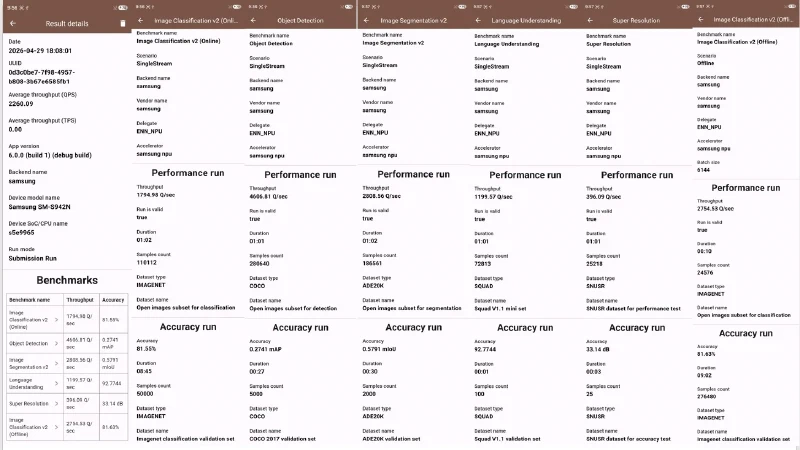
The rest of the suite covers image classification with MobileNetV4 on ImageNet, object detection on COCO 2017, segmentation with MOSAIC on ADE20K, language understanding with MobileBERT on SQuAD 1.1, super resolution with EDSR, and Stable Diffusion 1.5 on COCO captions, as the benchmark page lists them. Almost every test runs in the single stream scenario, where the score is the 90th percentile latency for one query at a time, and image classification also runs an offline pass scored as throughput. Stable Diffusion, the first generative test in the suite, arrived in the v4.1 app release of February 11, 2025. Mostafa El-Khamy, co-chair of the MLPerf Mobile working group, had set out the plan in May 2024.
Looking ahead, the MLPerf Mobile group is working to add generative AI tasks to a future version of the benchmark suite.
Results come from chip and device makers that run the app and submit their logs. The published v6.0 results hold one submission in the closed division, from Samsung on an Exynos 2600 phone, and it covers the vision tests, language understanding, super resolution and Stable Diffusion rather than the new Llama ones. Samsung’s logs give a 90th percentile single stream latency of 0.56 ms for image classification, 0.83 ms for MobileBERT and 1.87 s for one Stable Diffusion image. The v5.0 round carried submissions from Samsung and Qualcomm Innovation Center.
Screenshots: Samsung's submission to MLPerf Mobile v6.0, published by MLCommons.
Submissions are held back until review closes under the MLCommons submission rules, which keep every result confidential inside a review committee after the deadline and let submitters file objections that the committee then decides. MLCommons publishes the accepted runs in the results table on the MLPerf Inference Mobile page, with the logs and calibration notes in a per-round repository on GitHub. The app is available through Google Play, the Apple App Store and the MLPerf Mobile repository under the Apache 2.0 license.
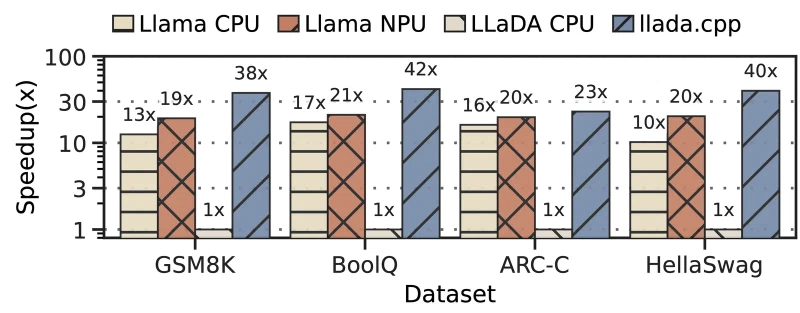
Tuowei Wang, Yanfan Sun and Ju Ren of Tsinghua University and Beihang University published llada.cpp on June 11, 2026, an inference framework that runs diffusion language models on a phone’s NPU. On an OnePlus Ace5 Pro with a Snapdragon 8 Elite, the authors measure LLaDA-8B-Instruct generating 128 tokens 38 times faster than the same model on the phone’s CPU for GSM8K prompts and 42 times faster on BoolQ, and they report a range of 17 times to 42 times across their phones and tasks. The same figure puts Llama-3-8B-Instruct on the NPU at 19 to 21 times that CPU baseline, and the authors state that llada.cpp runs LLaDA-8B up to 3.9 times faster than an autoregressive model of the same size.
Chart: Wang, Sun and Ren, CC BY 4.0.
A diffusion language model does not emit one token after another. It starts from a block of masked positions, 32 tokens by default here, and refines all of them together over repeated denoising steps, committing the positions it is most confident about and carrying the rest into the next step. That turns decoding into a run of large matrix operations, which is the work a mobile NPU is built for, while autoregressive decoding hands the NPU one token’s worth of work per step. The cost the paper identifies is that every denoising step recomputes the full sequence, so the parallel work gets repeated many times over.
llada.cpp is built on llama.cpp and targets Qualcomm’s Hexagon NPU with 4-bit weights. Once a block is nearly done only a few masked tokens are left, so the framework pulls tokens from the next block into the same NPU pass to keep it full, keeps already committed tokens open to revision and repairs the unstable ones on the CPU while the NPU carries on, and repacks the limited address space the NPU can see so weights and cache do not have to be remapped between steps. The authors’ breakdown of a 128-token GSM8K request on the Snapdragon 8 Elite puts it at 2996.2 s on the CPU, 607.0 s once the prefix KV cache is reused, and 16.1 s with the full framework.
Accuracy moves in both directions. Measured on 200-sample subsets against LLaDA-8B-Instruct on the CPU, the authors’ table has GSM8K rising from 39.0 to 43.5 and ARC-C from 84.0 to 85.0, while BoolQ falls from 82.5 to 80.5 and HellaSwag from 51.0 to 49.5, and their ablation shows the borrowed future-block tokens costing accuracy on all four tasks before the CPU-side revision path recovers it. The work covers three 16 GB phones, an OnePlus 12 with a Snapdragon 8 Gen 3, the Ace5 Pro, and an OnePlus 15 with a Snapdragon 8 Elite Gen 5, and the authors state that on the Snapdragon 8 Gen 3 their framework is still slower than Llama-3-8B at 128 tokens and only pulls ahead on the two newer chips. The paper is on arXiv under CC BY 4.0 and names no code release.
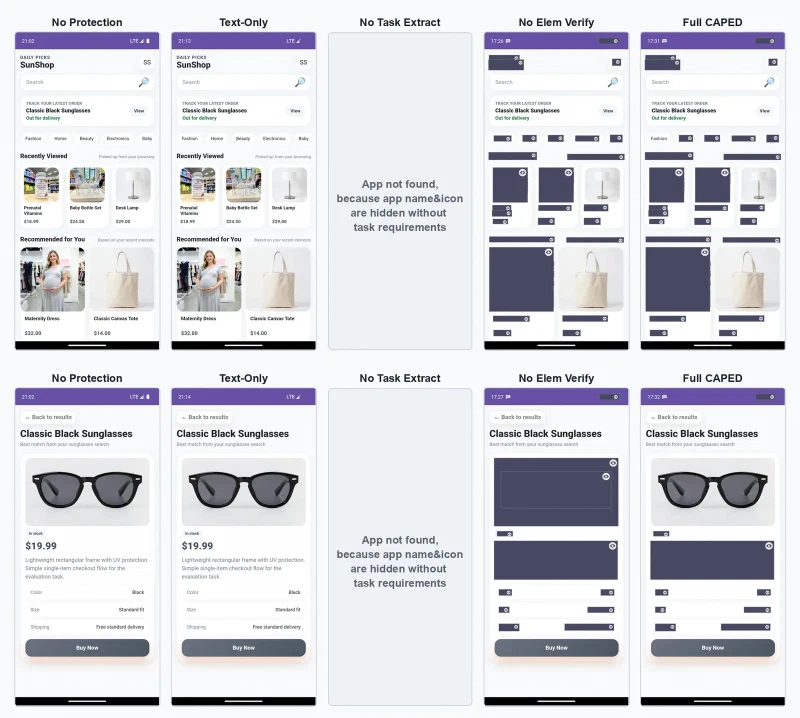
Researchers at the Chinese University of Hong Kong, Southeast University and Shandong University published CAPED on June 10, 2026, a filter that blacks out parts of a phone’s screenshots before they reach a cloud-hosted GUI agent. Across a 28-task privacy suite the authors built themselves, weighted seeded leakage falls from 0.766 with raw screenshots to 0.268 with the filter in front, counted only on runs where the agent still finished its task. A multimodal model plays the attacker and scores what it can still infer from the whole screenshot sequence, not from single frames.
A screenshot-based agent operates a phone the way a person does, by looking at the screen, so every image it uploads carries whatever happens to sit next to the thing the user asked for. The authors call this incidental visual privacy exposure and name contacts, message previews, non-target photos, filenames, recommendation feeds and health widgets as content the remote model receives although the user never mentioned it. In one of their test shops, a request to buy sunglasses puts prenatal vitamins, a baby bottle set and a maternity dress in front of the model, because the shop’s recommendation rows share the page with the product. Stripping names and numbers out of the text does not close that gap, and the authors measure text-only anonymisation at 0.752 against 0.766 for no protection at all.
Figure: Shen et al., licensed CC BY 4.0. The mock SunShop task asks the agent to buy sunglasses, so the personalised rows around it count as incidental exposure.
CAPED decides per interface element rather than per screen, according to the paper. It first sorts the current screen into one of three postures, so galleries, maps, files and financial views show their text but hide their images, while messaging, contacts, feeds and health dashboards hide both by default. The user’s instruction is turned into a short list of what the agent is allowed to need, and a hidden element is released only when it matches that list, checked either by text matching or by asking a vision model whether a cropped thumbnail really shows the requested subject. Hidden areas keep their place in the layout under a solid overlay with an eye icon, and names in exposed text are replaced by placeholders the remote agent can still follow.
The defence is meant to run on the phone, and the authors argue the instruction has to be interpreted locally too, since it can name people, relationships, locations and intentions before any screen policy applies. The prototype they measured does not run on a phone. They state that CAPED’s components ran on the evaluation host with an evaluation-side service for the heavier models, and that the timings should be read as live-loop prototype latency rather than physical-phone latency, energy or thermal behaviour. Over 1,394 measured steps the privacy work added 2.325 seconds per agent step, 22.6 percent of a 10.835-second step, most of it the detector at 1.811 seconds, plus 5.716 seconds once per task to extract the requirements.
The protection also costs task success. On AndroidWorld’s 116 ordinary tasks, GUI-Owl-7B completed 77 of them (66.4%) unprotected and 64 (55.2%) behind the full filter, which the authors call a prototype-level utility cost. They name further limits themselves, writing that screens their rule base does not cover fall back to the most permissive posture, which they describe as not privacy-conservative, and that open-ended requests such as finding the latest receipt widen exposure and account for much of the leakage that remains. On the connected Gmail, Drive and Photos tasks the filter moves leakage from 0.402 to 0.347 only, the interactive unmasking path was never tested with real users, and the authors write that they plan to release the CAPED artifact in a future public version.
Researchers working in the Swiss AI Initiative published a technical report on May 27, 2026 describing three language models distilled from Apertus 8B, at 0.5B, 1.5B and 4B parameters. The authors are based at EPFL, ETH Zurich and ISTA, and the models sit on Hugging Face as the Apertus Mini collection. They inherit what the project calls a fully open and compliant release, meaning published weights, published data pipeline and published recipe, with pre-training restricted to openly available data that honours robots.txt opt-outs. The model card lists 1,811 natively supported languages.
Each instruction-tuned model also ships in MLX format at 3, 4 and 6 bits, which the authors aimed at Apple devices and at memory-limited mobile and edge deployment. The 4-bit 4B weights are a 2.59 GB file against 7.65 GB for the same model in bfloat16, and the 1.5B and 0.5B come to 1.08 GB and 0.31 GB. The authors build the quantised copies with quantisation-aware distillation, a short recovery run that retrains the compressed weights against the 8B model’s own output distribution, and report 90% to 104% of the unquantised few-shot accuracy on ARC, HellaSwag, MMLU and WinoGrande. Separate FP8 and NVFP4 checkpoints target NVIDIA GPUs instead.
The base model table averages ARC, HellaSwag, WinoGrande, XNLI, XCOPA and PIQA, and puts the three sizes at 51.79, 56.66 and 61.53 against 64.96 for the 8B teacher. The same table gives the Qwen3 base models 52.23, 57.51 and 62.14 at comparable sizes, so the distilled models land just under them on the average while leading on the two cross-lingual sets, 45.03 against 43.00 on XNLI and 63.82 against 61.82 on XCOPA at 4B. On a multilingual average of MMLU, TruthfulQA, ARC, instruction following and LogiQA for the instruction-tuned models, the authors report 0.318, 0.382 and 0.473 against 0.401, 0.457 and 0.521 for Qwen3 and 0.497 for Gemma 3 4B, and write that the family is weaker at instruction following and maths.
Each model saw 1.7T tokens taken from the final and most heavily filtered phase of the original Apertus data, with no new sources added, packed into 4,096-token sequences and trained on 64 GH200 GPUs at the Swiss National Supercomputing Centre. The cost table puts the 4B run at 2.0E22 FLOPs and the single pass that produced the teacher’s logits for all three students at 1.4E22, against 3.7E23 FLOPs for the original Apertus 8B pre-training on 15T tokens, which the authors describe as making the whole family cost under 12% of the teacher. Swiss AI released 24 checkpoints in total, base, instruction-tuned and quantised, under the Apache 2.0 licence with an acceptable use policy attached, along with the training, post-training and quantisation code.
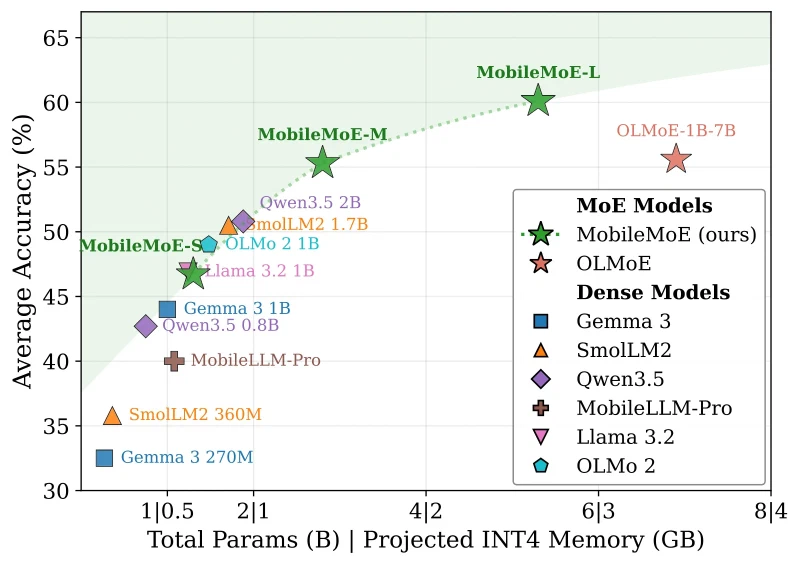
Meta AI published MobileMoE on May 26, 2026, a family of three language models for phones that hold 1.3B, 2.8B and 5.3B parameters but run only 272M, 528M and 922M of them on any given token. Each one is a sparse mixture of experts, meaning the feedforward block in every layer is split into 60 small networks plus one always-on shared network, and a router picks 4 of the 60 for each token while the rest sit idle. Per-token compute therefore follows the active count, and the memory footprint follows the total.
That split is what makes the models awkward to host on a phone. The authors quantise all three to 4 bits with quantisation-aware training, which puts the weights at 0.68 GB, 1.48 GB and 2.75 GB, because every expert has to be reachable even though only a few run per token. On a Samsung Galaxy S25 they measure peak resident memory during inference at 1.49 GB for the smallest model at an 8k context against 1.91 GB for the dense MobileLLM-Pro, and at 4.71 GB for the largest. Sizing the whole expert set to fit phone DRAM is the opposite of the route Edge0 takes, which streams expert weights off storage to keep a 35B model inside a couple of gigabytes.
The paper reports that peak memory under real prompts runs 1.2 to 2.1 times higher than under repeated dummy tokens for the mixture-of-experts models, while staying flat for the dense baseline, because varied input routes to more experts and pulls more of them into RAM. Meta AI therefore profiled with real code, knowledge and maths prompts and calls dummy-prompt figures a lower bound rather than a measurement.
The authors ran the models through ExecuTorch on the Galaxy S25 with a Snapdragon 8 Elite on 4 CPU threads and on an iPhone 16 Pro with an A18 Pro on 2 CPU threads, after writing a fused mixture-of-experts operator because mobile CPU backends ship none. On a 512-token prompt they measure the smallest model decoding at 130.0 tok/s on the Galaxy S25 against 56.5 for MobileLLM-Pro, and at 180.5 tok/s on the iPhone 16 Pro against 55.1. Time to first token on a 1k prompt drops from 4.26 s to 2.01 s on the Galaxy and from 6.03 s to 2.14 s on the iPhone. Across both phones, CPU and GPU, and the XNNPACK and MLX backends, Meta AI reports the smallest model running 1.8 to 3.8 times faster at prefill and 2.2 to 3.4 times faster at decode than the dense baseline at comparable 4-bit weight memory.
Across 14 benchmarks the authors score the instruction-tuned models at 46.7, 55.3 and 60.1 on average at 16-bit precision, against 42.7 for the dense Qwen3.5 0.8B, 44.0 for Gemma 3 1B, 46.9 for Llama 3.2 1B and 50.8 for Qwen3.5 2B, the last of which carries 1.9B active parameters. The largest model reaches 60.1 against 55.6 for Ai2’s OLMoE-1B-7B, with 30 percent fewer active and 23 percent fewer total parameters. After 4-bit quantisation those averages fall to 44.0, 52.5 and 57.8, which leaves the smallest model 1.5 points behind MobileLLM-Pro at 45.5 while scoring 9.4 points higher on MMLU. Meta AI states that the training data across all four stages comes from openly licensed public datasets, names no weight release, and lists mobile NPU deployment, expert pruning and mixed-precision quantisation as further work.
Chart: Meta AI. The authors' own comparison of instruction-tuned models at 16-bit precision, with the horizontal axis giving total parameters alongside the 4-bit weight footprint those imply.