Georgi Gerganov pushed the first commits of llama.cpp on March 10, 2023, according to the repository’s commit history. The project is an inference engine for Meta’s LLaMA models written in plain C and C++, and the README states its goal as language model and vision-language model inference with minimal setup and state-of-the-art performance on a wide range of hardware, locally and in the cloud.
The core implementation carries no external dependencies. It supports integer quantisation at 1.5, 2, 3, 4, 5, 6 and 8 bits, which is what brings models within reach of consumer memory budgets. Apple silicon is a first-class target through ARM NEON, the Accelerate framework and Metal.
The project has since added backends for x86 with AVX, AVX2, AVX512 and AMX, RISC-V, NVIDIA CUDA, AMD HIP, Moore Threads MUSA, Vulkan, SYCL, OpenCL and WebGPU. It is published under the MIT license.
Qualcomm AI Research has demonstratedStable Diffusion v1.5, a model with more than 1 billion parameters, running entirely on an Android phone powered by a Snapdragon 8 Gen 2. The company reports image generation in under 15 seconds for 20 inference steps at 512x512 pixels, a workload that until then ran in the cloud.
Images: Qualcomm. Sample outputs from the demo, generated on the phone.
To fit the model on the phone, Qualcomm quantised it from FP32 to INT8 using its AI Model Efficiency Toolkit and a post-training method called AdaRound, which adapts how individual weights are rounded. According to the company, the model needed no retraining after the conversion.
Inference runs through the Qualcomm AI Engine direct framework on the Hexagon processor, with the model prepared in Qualcomm AI Studio. The company sums up the result in its post.
This is the fastest inference on a smartphone and comparable to cloud latency.
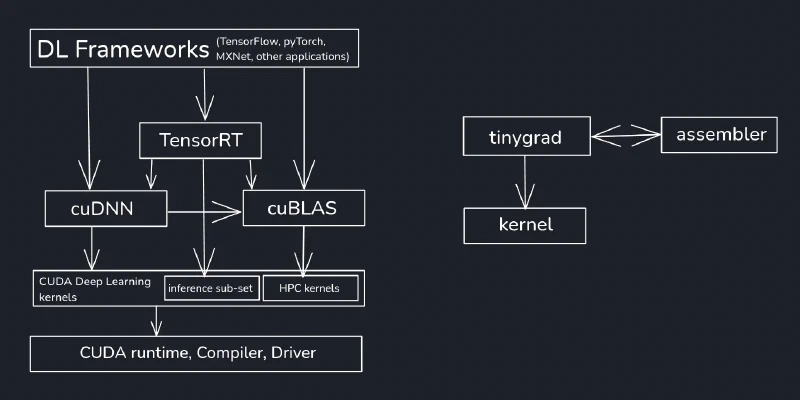
George Hotz pushed the first commit of tinygrad on October 18, 2020, with the message “start tinygrad”, according to the repository’s commit history. The README describes an end-to-end deep learning stack with a tensor library, an autograd, a compiler that fuses and lowers kernels, and a JIT, positioned between PyTorch and karpathy/micrograd. It also states that an accelerator port needs a total of about 25 low level ops. tiny corp, the company Hotz founded, maintains it.
The README lists backends for OpenCL, CPU, Metal, CUDA, AMD, NVIDIA, QCOM and WebGPU. The runtime documentation names the requirements for each one, Adreno 6xx series GPUs for the QCOM backend and M1 or newer Macs for Metal, with Metal 3.0 needed for bfloat support. The QCOM backend, which drives the Qualcomm GPU through the Adreno kernel driver interface instead of OpenCL, entered the repository on September 2, 2024, and the repository also carries a backend for Qualcomm’s Hexagon DSP in ops_dsp.py.
tiny corp states on its site that tinygrad is used in openpilot to run the driving model on the Snapdragon 845 GPU, where it replaces Qualcomm’s SNPE. The company says its framework is faster than SNPE, loads ONNX files, supports training and allows attention, which SNPE does not because it only allows fixed weights. The repository’s test workflow compiles an openpilot model with an image pitch alignment set to match the Adreno 630, the GPU in the Snapdragon 845.
The same workflow enforces the project’s size, failing the build when the repository goes over 26,500 lines as counted by sz.py. The repository ships a language model tool in tinygrad/llm that loads GGUF files, serves an OpenAI compatible API and benchmarks tokens per second, with a built-in model list that starts at quantised Llama 3.2 1B and Qwen3 0.6B. tinygrad is published under the MIT license, and the project recommends installing from source rather than from PyPI.
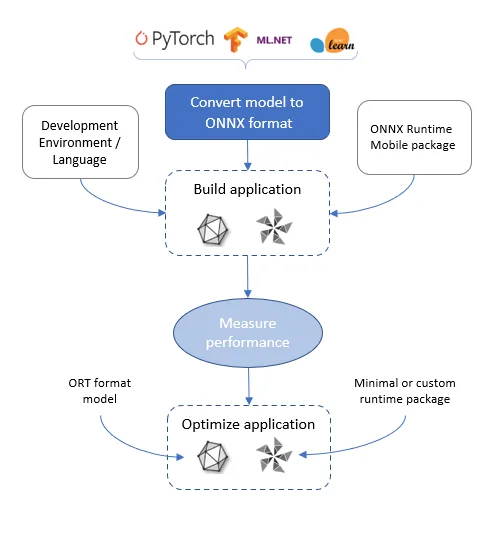
Microsoft released ONNX Runtime 1.5 on September 29, 2020 with a preview of ORT for Mobile Platforms, described in the release notes as minimising build size for mobile and embedded devices. The same release added a reduced operator kernel build, which compiles the runtime with only the operators the target models actually use, and the ORT model format that those reduced builds require. The format documentation records version 1 of the ORT format as introduced in 1.5.
Diagram: ONNX Runtime documentation.
The pre-built mobile packages, onnxruntime-android for Java, C and C++ and onnxruntime-c and onnxruntime-objc for iOS, carry the full operator set and load .onnx files directly, while a custom build takes models converted to the .ort format. Microsoft’s mobile guide puts numbers on the difference for version 1.18.0, where a custom build supporting the operators of a ResNet50 model produces an Android AAR of 7,532,309 bytes against 24,415,212 bytes for the pre-built package, and an arm64-v8a libonnxruntime.so of 3,962,832 bytes against 16,276,832 bytes.
Accelerators are called execution providers. The NNAPI provider requires Android 8.1 or higher and is recommended on Android 9 or higher, the Core ML provider requires iOS 13 or macOS 10.15 and higher, and the XNNPACK provider covers floating-point CPU work on both platforms. Microsoft’s guidance is to start on the CPU provider for a quantised model and on XNNPACK otherwise, then try NNAPI or Core ML if that misses the performance target. The QNN provider reaches Qualcomm Snapdragon chips on Android and Windows through the Qualcomm AI Engine Direct SDK, with pre-built packages for Windows only and an HTP backend that takes quantised models only.
Quantisation in ONNX Runtime is 8-bit linear quantisation, offered as dynamic and static post-training quantisation in two representations, QOperator with dedicated quantised operators and QDQ with QuantizeLinear and DequantizeLinear pairs inserted around the originals. The mobile guide states that moving 32-bit weights to 8 bits cuts model size by roughly a factor of 4. The tooling also does block-wise weight-only quantisation to int4 and uint4 for MatMul and Gather nodes, with RTN, HQQ and GPTQ algorithms, and models with GatherBlockQuantized nodes need ONNX Runtime 1.20 or later to run.
Generative models run through the separate onnxruntime-genai package, which implements the generation loop, KV cache management, search and sampling around the runtime. Its support matrix lists Android as supported and iOS as on the roadmap, with CPU, QNN, WebGPU, CUDA, DirectML and OpenVINO among the acceleration options. Microsoft reported in April 2024 that RTN int4 quantisation shrinks Phi-3 Mini enough to run on a Samsung Galaxy S21 at what it called a moderate speed, and recommends the int4_accuracy_level=4 variant on mobile. Both projects are published under the MIT license.
Researchers at Carnegie Mellon University and Google Brain published MobileBERT on April 6, 2020, a compressed version of the BERT language model built for phones. It has 25.3M parameters against 109M for BERT-base, and the authors measured 62 ms per inference on a Pixel 4, which they report as 4.3 times smaller and 5.5 times faster than BERT-base.
The saving comes from the shape of each layer. MobileBERT keeps the 24 layers of the much larger BERT-large but makes every block narrow, so that a block works internally at a width of 128 while the representation flowing between blocks stays 512 wide, with a small linear layer at each end to shrink the input and widen the output again, an arrangement the paper calls a bottleneck. Narrowing the block leaves the attention module holding too large a share of the parameters, so each block stacks 4 feed-forward networks behind its single attention module to restore the usual balance. The authors also traced a large part of the remaining latency to layer normalisation and the gelu activation and replaced both with cheaper operations, which cut inference from 192 ms to 62 ms without changing the number of arithmetic operations.
A network that deep and thin is hard to train directly, so the team first trained a teacher and then copied its behaviour layer by layer. The teacher is BERT-large fitted with inverted bottlenecks, which widen inside the block but narrow the representation passing between blocks to the same 512 the student uses, so the two models’ layer outputs line up and can be compared one to one during the transfer. That transfer happens only during pre-training, which keeps the result task-agnostic, so one distilled model is fine-tuned separately for each downstream task and no task-specific teacher is needed.
MobileBERT scores 77.7 on the GLUE language understanding benchmark against 78.3 for BERT-base, and on the SQuAD question answering sets v1.1 and v2.0 it reaches dev F1 scores of 90.0 and 79.2, which the authors put 1.5 and 2.1 above BERT-base. The latency figures are the authors’ own runs, with the models exported to TensorFlow Lite and timed on a 4-thread Pixel 4 at a fixed sequence length of 128, where BERT-base took 342 ms. A smaller variant with 15.1M parameters runs in 40 ms and scores 75.8 on GLUE, and 8-bit quantisation leaves the reported accuracies almost unchanged. Code and pre-trained weights are published in Google Research’s repository.
Hugging Face published DistilBERT on October 2, 2019, a compressed version of BERT trained by knowledge distillation, where a small student model learns to reproduce the output of a larger teacher. The student carries 66M parameters against BERT-base’s 110M, and Victor Sanh and his co-authors report it retaining 97% of BERT’s score on the GLUE language understanding benchmark while running 60% faster.
The authors tested the model on a phone by building a question-answering app for an iPhone 7 Plus and comparing it against their own BERT-base question-answering model. Excluding the tokenisation step, they measured DistilBERT at 71% faster, and the whole model in that app weighs 207 MB, which they note could shrink further with quantisation. On a server CPU at batch size 1, the same pair takes 410 seconds against 668 for a full pass over the STS-B development set.
Three losses train the student at once. A distillation loss pushes it towards the teacher’s full output distribution rather than only the correct token, a masked language modelling loss keeps BERT’s own pre-training objective in place, and a cosine embedding loss aligns the directions of student and teacher hidden state vectors. The student halves BERT’s layer count, drops the token-type embeddings and the pooler, and starts from every second layer of the teacher, an initialisation the ablation study values at 3.69 points of GLUE macro score. Training ran on eight 16 GB V100 GPUs for about 90 hours on English Wikipedia and the Toronto Book Corpus.
Hugging Face released the trained weights together with the training code in its transformers library, and published the iOS demo separately as Core ML code. The paper was accepted at the fifth Workshop on Energy Efficient Machine Learning and Cognitive Computing, co-located with NeurIPS 2019.
Researchers at Huawei Noah’s Ark Lab and Huazhong University of Science and Technology published TinyBERT on September 23, 2019, a compressed version of BERT-base trained by knowledge distillation, where a small student model learns to reproduce the behaviour of a larger teacher. The four-layer student carries 14.5M parameters against the teacher’s 109M, and the authors report it at 7.5x smaller and 9.4x faster on inference while reaching more than 96.8% of the teacher’s score on the GLUE language understanding benchmark. A forward pass costs 1.2B FLOPs against 22.5B for BERT-base.
Rather than fitting only the logits the teacher outputs, the authors define losses on the embedding layer output and, for every Transformer layer, on the hidden states and on the attention matrices those layers produce, following a finding by Kevin Clark and co-authors that BERT’s attention weights capture substantial linguistic knowledge. Dropping the attention term costs the most in their ablation, taking a four-task development average from 75.6 to 71.0, against 72.9 without the hidden states and 73.5 without the prediction layer logits. The distillation also runs twice, first as a general stage against the unfine-tuned BERT on a large text corpus, which produces a general TinyBERT that initialises the student, then as a task-specific stage against the fine-tuned BERT on a task dataset expanded by data augmentation. Removing either stage costs more still, with that same average falling to 72.5 without the general stage and 68.5 without the task-specific one.
On the GLUE test set the authors report the 14.5M-parameter model at an average of 77.0 against 79.5 for BERT-base, with 82.5 on MNLI-m, 92.6 on SST-2, 87.7 on QNLI, 71.3 on QQP, 86.4 on MRPC, 80.4 on STS-B and 66.6 on RTE. The widest gap is CoLA, the linguistic acceptability task, at 44.1 against 52.8. The authors measured the speedups on a single NVIDIA K80 GPU, not on a phone. A six-layer variant at 67M parameters averages 79.4, which the authors call on par with the teacher.
Huawei released the checkpoints on Hugging Face, where the general four-layer model is published as huawei-noah/TinyBERT_General_4L_312D alongside a six-layer version, with the training code in the company’s Pretrained-Language-Model repository on GitHub. The paper later appeared in Findings of EMNLP 2020.