Mobile AI news ticker

Monday 26 February 2024

Qualcomm AI Hub opens 75 pre-optimised models and profiling on hosted Snapdragon phones

Qualcomm launched Qualcomm AI Hub at Mobile World Congress in Barcelona on February 26, 2024, a developer service built around a model library of more than 75 pre-optimised AI and generative AI models for Snapdragon and Qualcomm platforms. Qualcomm states that spreading each model across the NPU, CPU and GPU of its AI Engine results in 4X faster inferencing times.

The second half of the service is measurement. A developer uploads a trained model, the hub compiles it for a chosen chip and runtime, then runs it on a physical Snapdragon device in Qualcomm’s cloud and returns latency, memory use and a numerical check against the original, as the documentation describes. The same measurements are published for every catalogue entry, which is why each model page names the handset the figures came from.
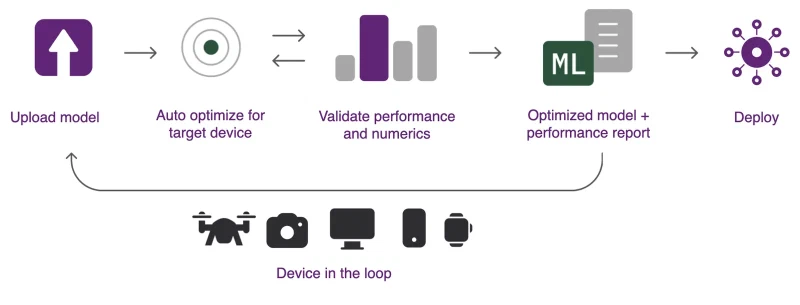
Workflow diagram running from upload model, to auto optimize for target device, to validate performance and numerics, to optimized model plus performance report, to deploy, with a loop back through drones, cameras, monitors, phones and watches labelled device in the loop
Diagram: Qualcomm.

At launch the export recipes in Qualcomm’s repository covered two runtimes, TensorFlow Lite and Qualcomm AI Engine Direct, on Android 11 and newer, in FP16, INT8 and INT4. The supported chips ran from the Snapdragon 845 through the Snapdragon 888 to the Snapdragon 8 Gen 3, with Samsung Galaxy S21 to S24, Xiaomi 12 and 13 and Google Pixel 3 to 5 handsets named as targets. Everything is driven from a Python package called qai_hub.

Two of the listed models generate text, Llama-v2-7B-Chat and Baichuan-7B, both quantised to 4-bit weights and 16-bit activations. Qualcomm’s model card puts Llama-v2-7B-Chat at 3.6 GB with a maximum context of 1024 tokens, and reports it measured on a Samsung Galaxy S23 Ultra running Android 13 on a Snapdragon 8 Gen 2, on the NPU, at 117.8 ms for each additional token and 2,578.5 ms to push a full 1024-token prompt through before the first token comes back. Peak memory for the token generator is 66 to 238 MB.

Qualcomm publishes the models on the AI Hub site, on GitHub and on Hugging Face, and names no price for the service, asking only for a Qualcomm ID to sign in and an API token to submit jobs. The licensing is layered. Qualcomm’s export and optimisation code is BSD 3-Clause, each model keeps the licence of the original implementation, so Llama-v2-7B-Chat stays under Meta’s terms, and the compiled assets prepared for on-device deployment carry a separate Qualcomm AI Hub Proprietary License.
Thursday 22 February 2024

Meta's MobileLLM trades width for depth and gains 2.7 and 4.3 points

Meta Reality Labs researchers published MobileLLM on February 22, 2024, a family of language models built to run on a phone rather than in a data centre. The paper argues that below a billion parameters the shape of the network matters more than the parameter count or the amount of training data. Its 125M and 350M models beat the previous best models at those sizes by 2.7 and 4.3 points on eight zero-shot common sense reasoning tasks.

The central finding is that depth beats width. The authors trained 19 models of roughly equal size but different proportions, 9 around 125M parameters and 10 around 350M, and report that 30-layer and 42-layer designs scored higher than the 12-layer shape used by OPT, GPT-Neo and Pythia at the same size. Sharing one weight matrix between the input embedding and the output layer removes 16M parameters, about 11.8% of a 125M model, for a 0.2 point accuracy drop the authors then recover by spending the freed budget on two more layers. Grouped query attention, where several query heads read one shared set of key and value heads, cuts 16 key-value heads to 4 at close to the same accuracy.

The paper sets out what a phone can actually spare. The authors put DRAM on current handsets at 6 to 12 GB, shared with the operating system and every other app, and argue that an app should not claim more than 10% of it. For energy they use a rule of thumb of 0.1 J per token per billion parameters, which puts a 7B model at 0.7 J/token, drains 0.2% of an iPhone battery every 64 tokens and allows under 2 hours of conversation at 10 tok/s. A 350M model with 8-bit weights costs 0.035 J/token by the same arithmetic, which the authors say covers a full day of use.

Meta also profiled the models on hardware rather than estimating. Running the 125M model in FP16 through ExecuTorch on an iPhone 13 with iOS 17.2.1 and the Metal Performance Shaders backend, the authors measured 39.2 ms to load, 1361.7 ms to initialise and 15.6 ms to execute, the last averaged over 50 runs. MobileLLM-LS, the layer-sharing variant, computes each transformer block twice in a row so that 30 blocks of weights behave like 60 layers at the same file size, a pattern the team picked over the alternatives because the repeated weights stay in the roughly 20 MB of on-chip cache instead of being fetched from DRAM again. That costs 2.2% more loading and initialisation time and 2.6% more execution time, against 143% and 86% for a model that really has 60 layers, and adds 0.7 and 0.8 points of accuracy at 125M and 350M.

After fine-tuning, MobileLLM-350M scores 3.28 on the MT-Bench chat benchmark against 1.37 for OPT-350M and 2.24 for the 1.3B OPT, and the layer-shared 350M wins 48.2% of AlpacaEval comparisons against text-davinci-001, a model that wins 50% against itself. For API calling the team built a synthetic set of 5,000 training and 2,500 test conversations that turn requests such as setting an alarm into a function call, and MobileLLM-350M scored 65.3 on intent exact match against 62.8 for Llama 2 7B, while trailing the larger model on the structure of the call and on the wording of the reply. Quantising weights and activations to 8 bits costs under 0.5 points. The work was published at ICML 2024 and the code is in Meta’s repository.

TinyLLaVA's 3.1B model outscores 7B LLaVA-1.5 on seven of nine benchmarks

Researchers at Beihang University and Tsinghua University posted TinyLLaVA on February 22, 2024, a framework for building small vision-language models out of an existing language model and an existing image encoder. Their best configuration, which the paper calls TinyLLaVA-3.1B, scores higher than the 7B LLaVA-1.5 on seven of the nine benchmarks in the paper’s comparison table, ties it on GQA at 62.0, and trails it on MME, where the same table gives LLaVA-1.5 1510.7 against 1464.9. The authors report 79.9 against 78.5 on VQAv2 and 75.8 against 63.4 on LLaVA-Bench-in-the-Wild, and put the model ahead of the 7B Qwen-VL on four of the five benchmarks they share, behind it on TextVQA at 59.1 against 63.8.

The framework treats four things as variables, the small language model, the vision encoder that turns an image into patch features, the connector that maps those features into the language model’s embedding space, and the training recipe. The authors instantiate it with TinyLlama at 1.1B, StableLM-2 at 1.6B and Phi-2 at 2.7B as language models, CLIP at 0.3B and SigLIP at 0.4B as vision encoders, and either the 558k-caption LLaVA-1.5 data or the 1246k-caption ShareGPT4V data. Their base recipe updates only the connector during pre-training, while their share recipe freezes the first 12 layers of the vision encoder and updates the rest of the model.

The ablations put most of the movement in the vision encoder and the recipe. Swapping CLIP for SigLIP raises the Phi-2 variant’s TextVQA score from 51.4 to 55.6 and the TinyLlama variant’s from 45.8 to 49.1, which the authors attribute in part to SigLIP running at 384 pixels against 336 and emitting 729 visual tokens against 576. A two-layer MLP connector beat a resampler on four of six benchmarks in the single comparison the paper runs, 74.0 against 70.1 on VQAv2 and 58.1 against 54.2 on GQA, with the resampler ahead on SQA-I and MM-Vet. The authors report that the share recipe, which fine-tunes part of the vision encoder rather than freezing all of it, improved every variant pre-trained on ShareGPT4V.

Model size still helps when data and recipe are held fixed, and with CLIP under the base recipe the Phi-2 variant leads the StableLM-2 and TinyLlama ones on all seven benchmarks in the appendix table. The ordering flips once the recipe changes, with the 1.5B SigLIP TinyLlama model on the share recipe beating the 1.9B CLIP StableLM-2 model on the base recipe on six of seven benchmarks. The authors add a hallucination caveat, reporting that the share recipe lowers POPE accuracy for the StableLM-2 and Phi-2 variants even as their other scores rise, and they conjecture that smaller language models need more trainable parameters during pre-training while larger ones suffer from them.

The paper carries no on-device measurement. It states no latency, no memory footprint and no target hardware, and argues the small-scale case from training and inference cost rather than from phone or edge deployment. The authors wrote that weights and code would be made public, and the project repository and the 3.1B weights carry the Apache 2.0 license.

Wednesday 21 February 2024

Gemma 2B and 7B open the Gemma line, built on Gemini research

Google released Gemma on February 21, 2024, the first two models in the line, at 2B and 7B parameters and in a pretrained and an instruction-tuned checkpoint each. The technical report presents the 7B as a model for deployment on GPU and TPU and the 2B as one for CPU and on-device applications. Google says Gemma was built from the same research and technology used to create Gemini and shares technical and infrastructure components with it.

Both sizes are decoder-only transformers trained on a context length of 8192 tokens. The 2B has 18 layers, a model dimension of 2048 and a single key-value head, since Google’s ablations found multi-query attention works well at small scale, while the 7B has 28 layers and keeps standard multi-head attention across 16 heads. Both inherit Gemini’s 256k-entry vocabulary, which puts 524M of the 2B’s parameters into embeddings and leaves 1.98B elsewhere. Google reports training the 2B on 3T tokens and the 7B on 6T, mostly English web documents, mathematics and code.

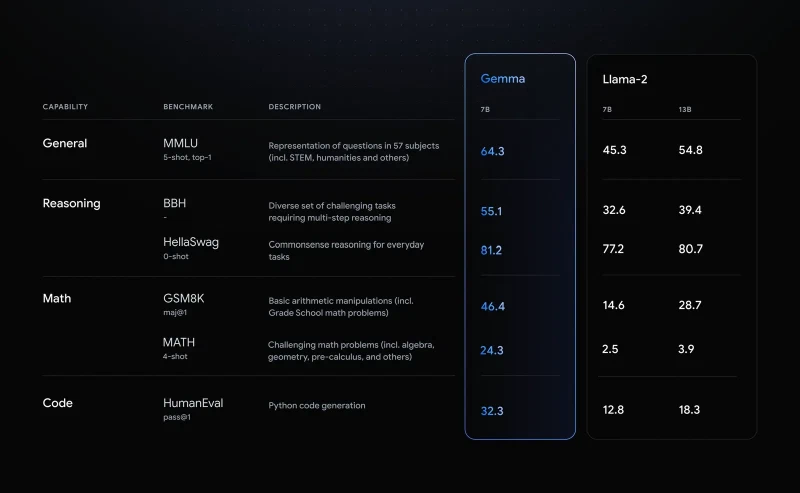
Google reports Gemma 7B at 64.3 on MMLU 5-shot against 54.8 for Llama-2 13B, 46.4 on GSM8K against 28.7, and 32.3 on HumanEval against 18.3, for an average of 56.9 across 18 academic benchmarks. Google puts the 2B at 42.3 on MMLU and 45.0 on average, ahead of Llama-2 7B on the mathematics and coding tasks and behind it overall. Google states that Gemma outperforms similarly sized open models on 11 of the 18 text-based tasks, and notes it could not rerun the Llama-2 evaluations itself because of that model’s licensing, so it cites Meta’s published figures.

Table of Google's benchmark figures showing Gemma 7B at 64.3 on MMLU, 55.1 on BBH, 81.2 on HellaSwag, 46.4 on GSM8K, 24.3 on MATH and 32.3 on HumanEval, each above Llama-2 7B and 13B
Google's own figures for Gemma 7B against Llama-2. Chart: Google.

The weights went up on Kaggle and Hugging Face, with the models also runnable from Colab and Vertex AI, and Google provided toolchains for inference and supervised fine-tuning across JAX, PyTorch and TensorFlow through native Keras 3.0. Hugging Face added Gemma to Transformers 4.38 on announcement day. llama.cpp merged Gemma support the same day, within half an hour of the pull request opening, which is what brought the 2B into quantised local runs on consumer hardware. Google states that the models run across laptop, desktop, IoT, mobile and cloud.

The weights are open but the licence is not a standard open source one. Google publishes them under its own Gemma Terms of Use, which allow use, modification and redistribution provided that downstream recipients get the same terms and the separate Prohibited Use Policy, and which reserve Google’s right to restrict uses it considers non-compliant. Google says the terms permit responsible commercial usage and distribution for all organisations regardless of size. Alongside the models Google shipped a Responsible Generative AI Toolkit with a safety classification method, a tool for debugging model behaviour and written guidance for model builders.

Tuesday 6 February 2024

MobileVLM V2 runs 1.7B, 3B and 7B vision models on 144 image tokens

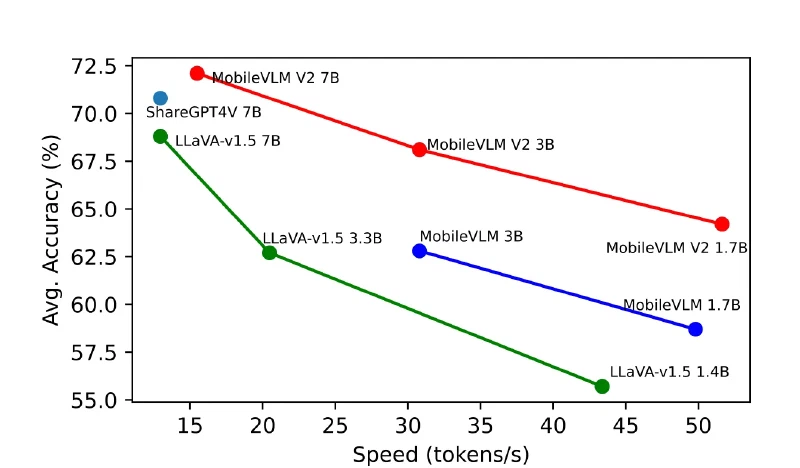
Researchers at Meituan, Zhejiang University and Dalian University of Technology published MobileVLM V2 on February 6, 2024, a family of vision language models at 1.7B, 3B and 7B parameters, each pairing a CLIP ViT-L/14 encoder that reads images at 336 by 336 pixels with a MobileLLaMA or Vicuna language model. Averaged over six benchmarks covering visual question answering, science questions, reading text in images, object hallucination and two multimodal test suites, the authors score the 1.7B model at 64.2 against 62.7 for LLaVA-1.5 3.3B, and the 3B model at 68.1 against 66.7 for MoE-LLaVA-2.7B×4, a mixture of experts where only part of the model is active per token. Their 7B model reaches 72.1, ahead of ShareGPT4V 7B at 70.8 and LLaVA-1.5 7B at 68.8 on the same average.

The authors measured generation over 256 output tokens on an NVIDIA AGX Jetson Orin developer board, not on a phone, with the language model quantised to 4-bit and run through llama.cpp. They report 51.63 tok/s for the 1.7B model, 30.80 tok/s for the 3B and 15.49 tok/s for the 7B, against 43.39, 20.45 and 12.96 tok/s for the three LLaVA-1.5 sizes in the same table. The authors state they wrote their own CUDA implementation of the new projector for that board.

Scatter plot of generation speed against average accuracy on six benchmarks, with the three MobileVLM V2 models on a line above and to the right of the MobileVLM and LLaVA-1.5 lines, reaching 64.2 percent at 51.6 tok/s and 72.1 percent at 15.5 tok/s
Chart: Chu et al., measured on an NVIDIA Jetson Orin with llama.cpp.

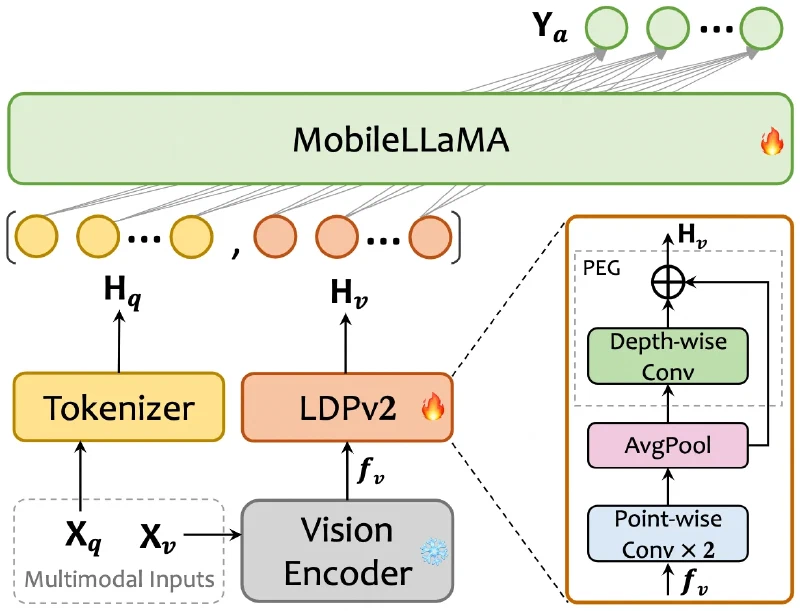
Most of the speed comes from how much of the image reaches the language model. The encoder turns a 336 by 336 picture into 576 patch tokens, and the projector between the two models, which the authors call LDPv2, first runs two 1 by 1 convolutions to match the language model’s width. It then averages every 2 by 2 block of neighbouring patches into a single token, leaving 144, and finally adds a small depthwise convolution back onto the result so each surviving token keeps a sense of where it sat in the picture. That positional part holds 0.02M parameters against 12.64M for the equivalent block in the first MobileVLM, and the whole projector 6.32M against 18.94M, while the six-benchmark average in the authors’ ablation rises from 62.8 to 64.2.

Architecture diagram showing a frozen vision encoder feeding the LDPv2 projector, built from two point-wise convolutions, average pooling and a depth-wise convolution with a skip connection, whose tokens join the tokenised text in MobileLLaMA
Diagram: Chu et al., MobileVLM V2.

Dropping tokens costs accuracy on fine detail. The authors removed the pooling step from the 7B model, which leaves all 576 tokens and puts it at the same latency as ShareGPT4V, and the six-benchmark average rises from 72.1 to 73.5, with most of the gain on TextVQA, a reading task full of small objects. vivo AI Lab took the same 2 by 2 merge further nine months later in BlueLM-V-3B, cutting 729 tokens per image tile to 196 and measuring the result on a phone NPU.

The rest of the gain over the first MobileVLM comes from data and from what stays trainable. The authors pretrain on 1.2 million captioned images from ShareGPT4V, then run a second stage over 2.4 million samples drawn from Visual Dialog, TextVQA, COCO Caption, SBU and other academic sets, 3.6 million in total, and they train the projector together with the language model in both stages while the vision encoder stays frozen, where LLaVA-1.5 and the first MobileVLM keep the language model fixed during pretraining. Both stages together took 8 NVIDIA A100 GPUs for about 14 hours. Meituan put weights for all three sizes on Hugging Face the same day, and the code is published under the Apache 2.0 license.

Wednesday 17 January 2024

Galaxy S24 becomes the second phone line to run Gemini Nano

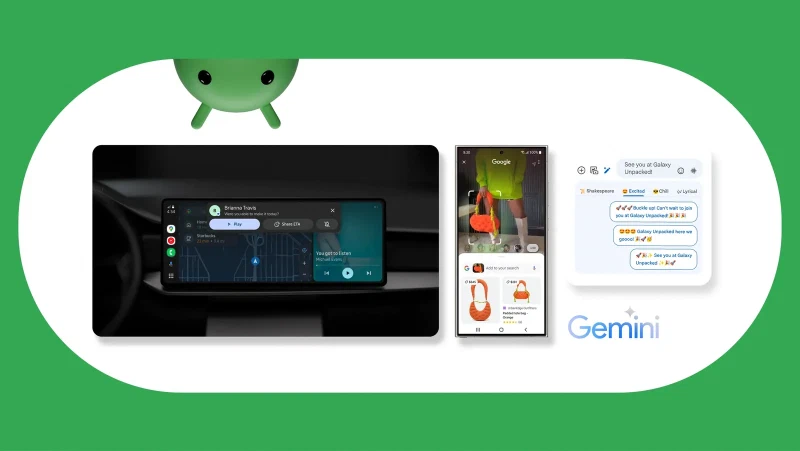
Google announced on January 17, 2024 that the Galaxy S24 series runs Gemini Nano on device, which made it the first phone line outside the Pixel 8 Pro to do so. Google names Magic Compose in Google Messages as the feature that runs locally, and states that the data does not leave the phone.

Product collage showing Android Auto on a car screen, Circle to Search on a Galaxy phone and Magic Compose reply suggestions labelled Shakespeare, Excited, Chill and Lyrical
Image: Google.

The rest of the announced features run in the cloud. Google lists Gemini Pro behind summarisation in Samsung Notes and Voice Recorder as well as keyboard features, with Generative Edit in the Gallery app built on Imagen 2. Gemini Ultra was still in testing at the time.

The launch also introduced Circle to Search, a gesture that searches whatever is circled or highlighted on screen without switching apps. Samsung published its own account of the launch on the Samsung Newsroom.

Arm runs Llama 2 7B at 9.6 tokens per second on three mobile CPU cores

Arm showed a chat assistant running Meta’s Llama 2 7B on existing Android phones using three Cortex-A700 series CPU cores and LPDDR5x memory, at a text generation rate of 9.6 tokens per second. Gian Marco Iodice and Adnan AlSinan published the demo video and the measurement on January 17, 2024, and state that the video runs at actual speed and that everything runs locally on the device. Arm says the rate is faster than average human reading speed.

Integer quantisation is what brought a 7B model into phone memory, according to Arm’s write-up. Arm puts the RAM needed for Llama 2 7B with 16-bit floating point weights at about 14 GB, and says quantising those weights to 4-bit shrinks the model four times, to roughly 4 GB. Arm warns that going down to 3-bit or 2-bit costs accuracy. Pinning each worker thread to a specific core with a thread affinity mask, rather than letting Android’s scheduler place it, improved latency by over 10 percent in Arm’s tests.

Arm then wrote its own 4-bit matrix-by-vector and matrix-by-matrix routines, the two functions that dominate the work in a language model, tuned for Cortex-A700 series cores. The routines are built on two instructions the cores already carry, SDOT for dot products and SMMLA for 8-bit integer matrix multiply and accumulate. Arm reports that they cut the time to the first token by over 50 percent and raised text generation by 20 percent against the native implementation in llama.cpp, and said at the time that the routines would be available soon.

Arm makes the case for the CPU on the shape of the workload rather than on peak throughput, arguing that the typical batch size and the balance of compute and bandwidth in language model inference suit a CPU, and that its programmability lets developers try new compression and quantisation schemes. The post names no NPU or GPU and offers no comparison against one. Arm puts the reach of the approach at around 99 percent of smartphones worldwide and says 70 percent of AI in third-party applications already runs on Arm CPUs.

Arm later extended the same post with a second demo, a teaching assistant chatbot built on Microsoft’s Phi-3 3.8B, which Arm measures at just over 15 tokens per second on the same software optimisations. Arm names the Scalable Matrix Extension for Armv9-A as the next hardware step for these workloads.

Thursday 4 January 2024

TinyLlama pretrains a 1.1B model on 3 trillion tokens

Researchers from the StatNLP group at Singapore University of Technology and Design published TinyLlama on January 4, 2024, a language model of 1.1B parameters pretrained on 3 trillion tokens. The authors set out to see how a small model behaves when it is trained on far more tokens than the compute-optimal scaling law of Hoffmann et al. recommends for its size, and they state that this is, to their knowledge, the first attempt to train a model of around 1B parameters on that much data.

The corpus mixes natural language from SlimPajama with code from the StarCoder training data at a sampling ratio of roughly 7 to 3, which the authors put at about 950 billion tokens once the two are merged and the GitHub part of SlimPajama is dropped to avoid duplication. TinyLlama passes over that set for approximately three epochs, which is how the 3 trillion cumulative figure is reached. Pretraining ran on 16 A100-40G GPUs, and the project repository states that the run started on September 1, 2023 and was budgeted at 90 days.

TinyLlama copies the architecture and tokenizer of Meta’s Llama 2, so it carries rotary position embeddings, RMSNorm pre-normalisation and SwiGLU activations across 22 layers with a hidden size of 2048 and a 2048-token context. It also inherits grouped-query attention, where the 32 query heads share four groups of key and value representations instead of each head holding its own, which the authors use to cut memory bandwidth and speed up inference. They report a training throughput of 24,000 tokens per second per A100-40G GPU, and measure 3,456 GPU hours to cover 300 billion tokens against 4,830 hours for Pythia-1.0B and 7,920 for MPT-1.3B in their own comparison. They attribute that speed to existing open-source components rather than anything new, naming Fully Sharded Data Parallel for spreading training across nodes, FlashAttention-2, fused implementations of layer normalisation, the cross entropy loss and the rotary position embedding, and the fused SwiGLU module from xFormers.

Across seven zero-shot commonsense reasoning benchmarks the authors’ own table puts TinyLlama at an average of 52.99, ahead of OPT-1.3B at 51.44, Pythia-1.4B at 51.33 and Pythia-1.0B at 48.30, with the widest margin on HellaSwag at 59.20 against 53.65 for OPT-1.3B. It does not lead every column, and Pythia-1.4B stays ahead on BoolQ at 63.27 against 57.83. On the InstructEval suite TinyLlama averages 19.87 against 17.72 for Pythia-1.4B and 16.95 for OPT-1.3B, with most of that difference coming from HumanEval, where it scores 9.15 against 4.27.

The authors put the device case briefly, writing in the paper that the compact architecture “can enable end-user applications on mobile devices”, and the repository describes the model as suited to applications with a restricted computation and memory footprint. It puts the 4-bit quantised weights at 637 MB and names offline real-time machine translation and drafting tokens that a larger model then checks as the uses it has in mind. Neither the paper nor the repository reports a measurement on a phone. Weights and all intermediate checkpoints are on Hugging Face under Apache 2.0, with the pre-training code in the repository.

Tuesday 12 December 2023

Microsoft releases Phi-2, a 2.7B model it says matches models 25 times larger

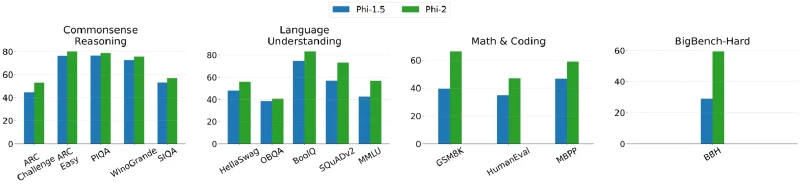
Microsoft released Phi-2 on December 12, 2023, a base language model with 2.7 billion parameters. The company says that on complex benchmarks it matches or outperforms models up to 25 times larger, and that it surpasses Mistral and Llama-2 at 7B and 13B parameters on various aggregated benchmarks. Microsoft’s own table scores Phi-2 at 53.7 on grouped coding benchmarks against 38.3 for Llama-2-70B, and at 61.1 on math against 64.1 for the same model. Against Google’s Gemini Nano 2 at 3.2B, Microsoft reports 59.3 versus 42.4 on BigBench-Hard and 59.1 versus 27.2 on MBPP, using Google’s own reported figures for the comparison.

Microsoft trained the model on 1.4 trillion tokens from multiple passes over a mixture of synthetic and web data for language and code, following what it calls textbook-quality data. The synthetic sets were written to teach common sense reasoning and general knowledge such as science, daily activities and theory of mind, and the web portion was filtered for educational value and content quality. The model card puts the underlying dataset at 250 billion tokens, combining synthetic text generated with GPT-3.5 and web data from Falcon RefinedWeb and SlimPajama that was assessed with GPT-4.

Microsoft did not train Phi-2 from scratch. It started from the 1.3-billion-parameter Phi-1.5 and embedded that model’s knowledge inside the larger one, a step the company says both accelerates training convergence and raises Phi-2’s benchmark scores. Training then took 14 days on 96 A100 GPUs, and the model card lists a context length of 2048 tokens. Phi-2 is a base model that went through neither reinforcement learning from human feedback nor instruction tuning.

Bar chart comparing Phi-1.5 and Phi-2 on commonsense reasoning, language understanding, math and coding, and BigBench-Hard, with Phi-2 ahead in every task and the widest gaps on GSM8K, MBPP and BBH
Chart: Microsoft's own evaluation figures for the two models.

Microsoft published the weights in the Azure AI Studio model catalog and on Hugging Face, where the first model card, dated December 13, 2023, named the Microsoft Research License and limited use to research. Microsoft replaced that file on January 5, 2024, and the model card has since stated “The model is licensed under the MIT license”, which the repository’s commit history dates to that day.

Apple researchers run models twice the size of available DRAM from flash

Apple researchers published LLM in a flash on December 12, 2023, a method for running language models that do not fit in a device’s memory. By keeping parameters in flash storage and loading them into DRAM only when needed, the paper reports running models up to twice the size of the available DRAM.

Two techniques carry the result. Windowing reuses neurons that were already loaded for recent tokens, which reduces how much data has to move. Row-column bundling arranges the weights so that reads follow the sequential access patterns flash memory handles best.

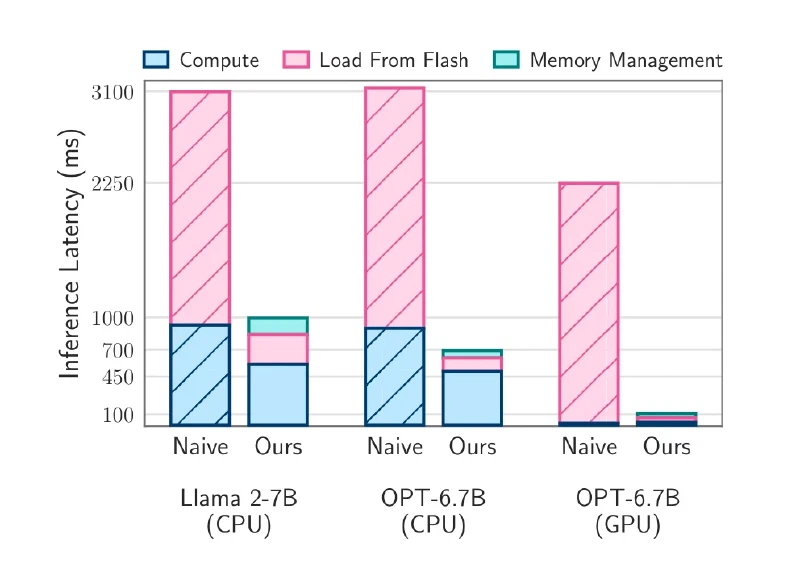
Measured against naive loading from flash, the authors report a 4 to 5 times increase in inference speed on CPU and a 20 to 25 times increase on GPU. The paper was last revised in July 2024.

Stacked bar chart comparing naive loading and the paper method for Llama 2 7B and OPT 6.7B, splitting latency into compute, load from flash and memory management
Chart: Alizadeh et al. Latency per token when only half the model fits in memory.

Thursday 7 December 2023

Stability AI releases StableLM Zephyr 3B for edge devices

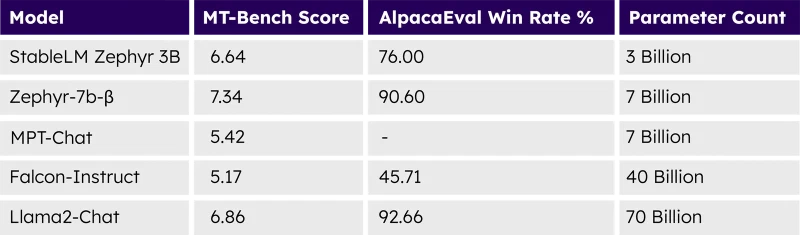
Stability AI released StableLM Zephyr 3B on December 7, 2023, a chat model with 3 billion parameters that the company aims at edge devices and hardware without the compute of dedicated high-end systems. Stability calls the model 60% smaller than 7B models and reports an MT-Bench score of 6.64 and an AlpacaEval win rate of 76.00%.

Both numbers are Stability’s own, measured on two evaluations the company links from the announcement. MT-Bench scores answers to open-ended questions with a larger language model acting as judge, and AlpacaEval measures how often a judge prefers a model’s reply over a reference answer. In the table Stability published with the model card, the 3B model sits above Falcon-Instruct at 40B parameters, which scored 5.17 on MT-Bench, and MPT-Chat at 7B with 5.42, and below Zephyr-7b-beta at 7.34 and Llama2-Chat at 70B with 6.86.

Table comparing MT-Bench scores and AlpacaEval win rates, with StableLM Zephyr 3B at 6.64 and 76.00 percent against Zephyr-7b-beta at 7.34, MPT-Chat at 5.42, Falcon-Instruct 40B at 5.17 and Llama2-Chat 70B at 6.86
Table: Stability AI, the company's own benchmark figures.

The model extends Stability’s earlier StableLM 3B-4e1t and borrows its training pipeline from Hugging Face’s Zephyr 7B, according to Stability. Stability first ran supervised fine-tuning on the UltraChat, MetaMathQA, Evol Wizard and Capybara instruction datasets, then aligned the result with direct preference optimisation, which trains a model on pairs of preferred and rejected answers instead of on correct answers alone. That second stage used UltraFeedback from the OpenBMB research group, a set of 64,000 prompts with model responses.

Stability put the weights on Hugging Face and linked an example notebook for tuning the model’s speed. The release is not open source. Stability states that it ships under a non-commercial community licence permitting non-commercial use, and tells anyone who wants the model in a commercial product to contact the company for separate terms.

Wednesday 6 December 2023

Gemini Nano ships on the Pixel 8 Pro and Android gets AICore

Google brought Gemini Nano to the Pixel 8 Pro in its December 2023 feature drop, where it powers Summarize in Recorder and Smart Reply in Gboard. Google calls the Pixel 8 Pro the first smartphone engineered for Gemini Nano and runs the model on the Tensor G3.

Video: Google. Gemini Nano summarising a recording in the Recorder app. Open the Android Developers post

According to Google, running the model locally helps prevent sensitive data from leaving the phone and lets the features work without a network connection. Summarize in Recorder launched in English. Smart Reply in Gboard launched globally on the United States English keyboard layout, starting with WhatsApp, Line and KakaoTalk.

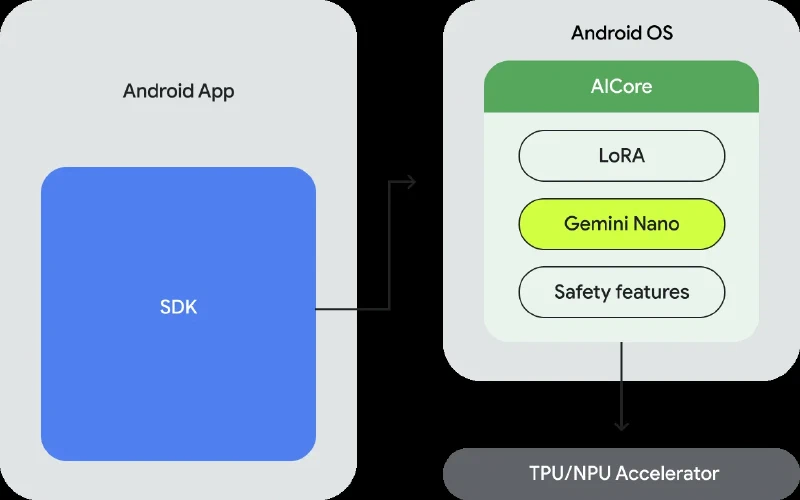
On the same day Google introduced AICore, a system service in Android 14 that handles model management, runtimes and safety features for Gemini Nano. It supports Low Rank Adaptation, so developers can build small adapters trained on their own data, and it targets the Google Tensor TPU as well as NPUs from Qualcomm, Samsung and MediaTek. Google describes the service as isolated from the network by design and opened access through an early access programme.

Diagram showing an Android app calling an SDK that reaches AICore in Android OS, which holds LoRA, Gemini Nano and safety features and drives a TPU or NPU accelerator
Diagram: Google.